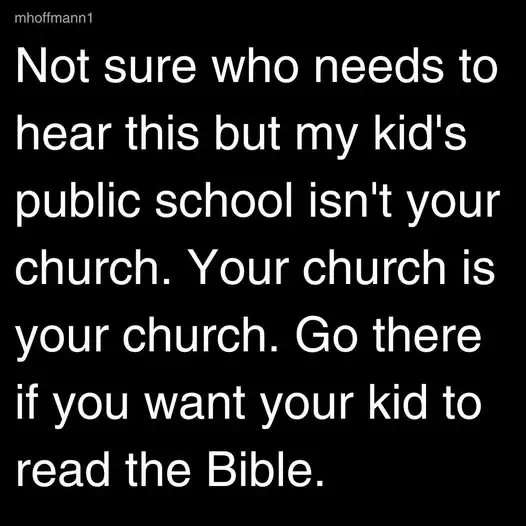
An informal social media post has ignited a heated debate about the boundaries between education and religious influence, highlighting tensions in today’s increasingly polarized society. The post features a straightforward message: “Not sure who needs to hear this but my kid’s public school isn’t your church. Your church is your church. Go there if you want your kid to read the Bible.” The declaration has quickly gone viral, drawing both support and criticism from parents, educators, and religious communities alike.
The statement underscores a common concern among many parents about the perceived mixing of religious teachings with public education. Critics argue that some school districts may be overstepping their bounds, subtly or overtly introducing religious content into classrooms—especially in areas where religious expression is a sensitive, hot-button issue.
Supporters of the message see it as a reminder of the importance of maintaining the separation of church and state, a principle enshrined in the U.S. Constitution. Justice Department guidelines and numerous court rulings emphasize that public schools are funded by taxpayers and therefore should remain neutral regarding religion. The concern, as expressed in the viral post, is that some schools might be crossing this line, intentionally or not, by including religious texts or teachings as part of their curricula.
On the flip side, defenders of religious expression in public settings argue that a broad, inclusive approach allows students to explore different belief systems, including reading religious texts like the Bible, as part of a balanced education. They stress that it is possible to teach religious history and literature without endorsing particular faiths—an approach many educators implement with care.
This social media outburst also raises questions about individual rights and community values. While some see the call for separation as essential to maintain neutrality in public institutions, others feel it restricts personal freedoms and the character of their communities. The viral nature of the message illustrates how deeply intertwined these issues are with personal identity and cultural values in America today.
Experts recommend that parents stay informed about what is being taught in their child’s schools and engage actively through school boards and community meetings. Open dialogue can often bridge gaps and foster mutual understanding among differing viewpoints.
Ultimately, the conversation epitomized by this social media post is a microcosm of larger debates about religion, education, and individual rights—debates that continue to shape policies and perceptions across the country. Whether viewed as a necessary reminder or an overreach, the message resonates with many parents and community members seeking a clear boundary between education and religious indoctrination.
Where to Learn More
- The ACLU on Separation of Church and State – American Civil Liberties Union
- U.S. Department of Education’s Guidelines on Religion and Public Schools
- Heritage Foundation: The Importance of Maintaining Church-State Separation in Schools
- NPR: What the Separation of Church and State Means for Public Schools