
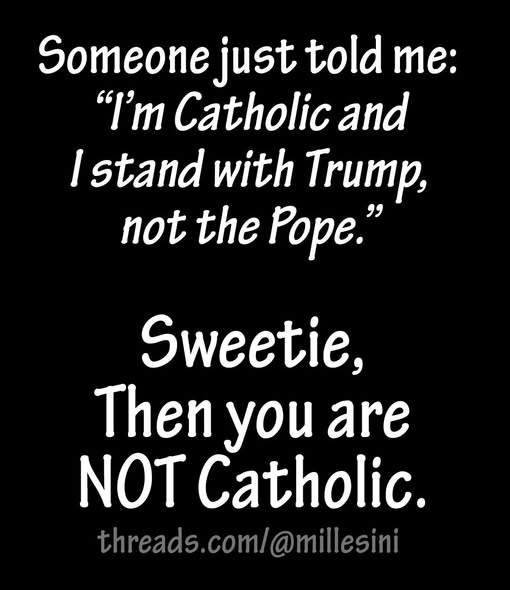
A recent viral social media exchange has ignited a heated debate online about what it truly means to be Catholic in today’s polarized world. The controversy began when a user shared a startling statement: “Someone just told me: ‘I’m Catholic and I stand with Trump, not the Po.'” This cryptic message quickly gained traction, prompting widespread discussion about the boundaries of faith and political allegiance within religious communities.
The phrase, which was accompanied by an image displaying the text, sparked immediate backlash and curiosity. Many followers questioned whether holding political endorsements aligns with authentic Catholic principles. The phrase seemed to imply that supporting certain political figures, specifically former President Donald Trump, might be incompatible with being a devout Catholic. Critics argued that such views oversimplify the complex relationship between faith and politics, while others insisted that loyalty to a political figure could conflict with core Catholic teachings.
Adding fuel to the fire, the original poster responded with a defiant message, stating, “Then you are NOT Catholic,” suggesting that political support outside certain boundaries disqualifies an individual from being a true Catholic. This bold assertion touched off a flurry of threads and replies, with some users defending their right to believe that supporting Trump does not negate their Catholic identity, while others felt the statement underscored the importance of aligning one’s political views with religious doctrines.
The controversy exposes a larger conversation happening in many faith communities — how do believers navigate their political opinions without compromising their spiritual integrity? Some experts argue that faith and politics are inherently intertwined, while others maintain that religious teachings should remain separate from partisan conflicts.
Notably, the debate also underscores the influence of social media in shaping religious identity and discourse. Platforms like Twitter and Threads have become battlegrounds for ideological clashes, often reducing complex issues into stark binaries. This particular exchange exemplifies how digital interactions can intensify divides, sometimes overshadowing meaningful dialogue with memes and sharp remarks.
While the debate illustrates differing perspectives, it also raises awareness about the importance of understanding religious teachings and respecting diverse interpretations within faith communities. Catholic leaders and scholars have emphasized that true adherence to Catholic doctrine involves love, humility, and a focus on moral principles rather than political allegiance. As one church official noted, “Being Catholic is about living the Gospel, not endorsing any political candidate.”
In the end, this viral incident serves as a reminder of the ongoing struggle to reconcile faith with the modern political landscape. It challenges believers to reflect on what authenticity means in their spiritual journey and how they express their faith in a divided world.