
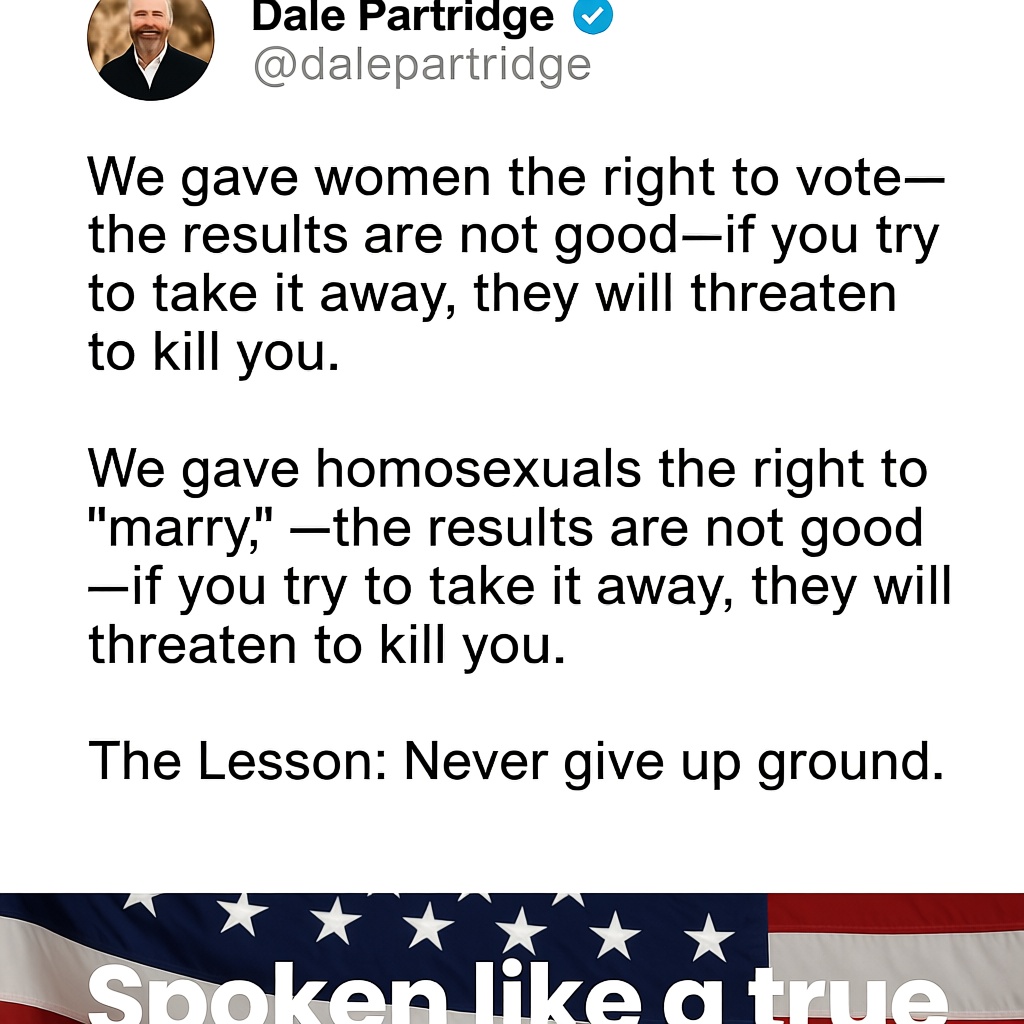
A recent social media post by entrepreneur and author Dale Partridge has ignited a wave of controversy and debate across online platforms. In a message that has quickly gone viral, Partridge made provocative claims about the consequences of granting women the right to vote and the broader impacts of social freedoms.
In his post, Partridge declared, “We gave women the right to vote — the results are not good. If you try to take it away, they will threaten to kill you.” This statement, which has been widely shared and criticized, appears to challenge the legitimacy and outcomes of voting rights, especially for women. Critics argue that such remarks are unfounded and dangerously misleading, as they overlook the significant advances in gender equality and democratic participation over the past century.
Adding to the controversy, Partridge also touched on other social issues, claiming, “We gave homosexuals the right to marry, and now society is facing unprecedented challenges.” While the assertion is stark, it prompts questions about the impact of social freedoms on societal stability and cohesion—topics that remain hotly debated among policymakers, activists, and the public alike.
Experts in political science and social policy have responded swiftly, emphasizing that granting rights, such as voting or marriage equality, has historically contributed to more inclusive and equitable societies. Dr. Laura Simmons, a sociologist at the University of Chicago, states, “Claiming that social progress leads to societal decline is not only inaccurate but also dismisses the positive effects of inclusion and civil rights on overall social health.”
The post’s inflammatory tone has sparked online outrage, with many users accusing Partridge of promoting divisiveness and spreading misinformation. Social media platforms have seen calls for fact-checking and moderation, as debates over civil liberties, gender equality, and social values continue to dominate digital conversations.
It’s essential to approach such provocative statements critically. While free speech is a protected right, spreading claims that insinuate violence or threaten societal stability can have serious repercussions. Experts advise verifying information from reputable sources and engaging in respectful dialogue on sensitive issues.
As society grapples with these complex topics, it’s clear that the discussions prompted by Partridge’s post reflect ongoing tensions about the direction of social and political change. The importance of fostering understanding and evidence-based debate cannot be overstated, especially on topics that deeply impact the fabric of democratic societies.
Where to Learn More
- The Impact of Expanding Voting Rights – Brookings Institution
- Public Opinion on Same-Sex Marriage – Pew Research Center
- Social Justice and Public Health – CDC
- A Brief History of Women’s Voting Rights – History.com