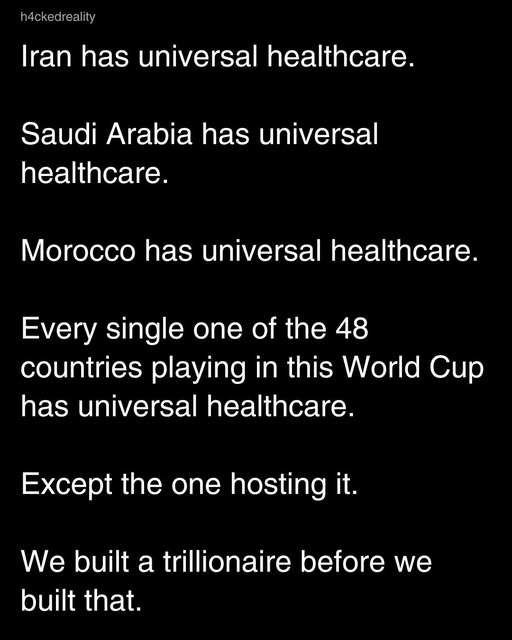
A recent viral social media post has ignited widespread discussion by revealing an often-overlooked commonality among a diverse set of nations: **all 48 countries participating in the current international event reportedly offer universal healthcare to their citizens**. The message, accompanied by an eye-catching image that reads “h4ckedreality,” underscores a surprising trend that challenges many stereotypes about healthcare disparities across different regions.
The post points out that, regardless of geopolitical differences, economic status, or regional conflicts, these 48 nations have achieved a significant milestone: providing healthcare that is accessible and free or affordable for all. Countries such as Iran, Saudi Arabia, and Morocco — each with distinct cultural, economic, and political landscapes — are cited as examples of nations prioritizing health coverage for their populations.
This revelation is compelling because it contrasts sharply with common perceptions in some parts of the world where healthcare remains a contentious or fragmented issue. In fact, universal healthcare is often associated with high-income nations like the UK, Canada, and Scandinavian countries. However, the viral post emphasizes that universal access to healthcare isn’t exclusive to the Western world.
Many of these nations have made conscious policy decisions to ensure their populations have consistent access to medical services, including preventive care, emergency services, and chronic disease management. In Iran, for example, the government’s healthcare system provides coverage for the majority of its citizens, despite international sanctions and economic challenges. Similarly, Saudi Arabia’s robust healthcare infrastructure is funded by its oil revenue, offering free or heavily subsidized services.
In Morocco, recent healthcare reforms have expanded access and improved health outcomes, particularly in rural areas. The common thread appears to be a strong governmental commitment to health as a human right — a stance that directly contrasts with many countries where healthcare access can depend heavily on employment status or socioeconomic class.
Critics and supporters alike are debating the implications of this reveal. Supporters argue it demonstrates how political will and strategic investment can result in equitable healthcare. Critics, meanwhile, caution that the post may oversimplify complex issues, such as healthcare quality, infrastructure challenges, and the specific scope of the coverage in each country.
Nevertheless, the viral image serves as a powerful reminder: universal healthcare is increasingly a global norm rather than an exception. It challenges assumptions and invites policymakers, health professionals, and citizens worldwide to reflect on the progress made — and the work still needed — to ensure health equity for all.