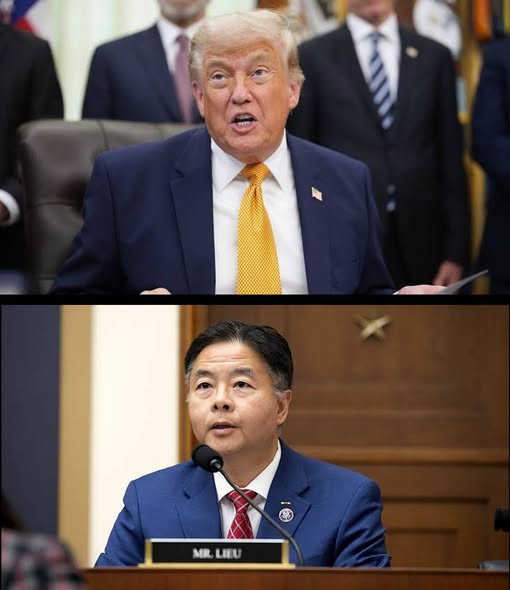
In a recent social media storm, former President Donald Trump once again pointed fingers at shadowy “vandals” as the culprits behind the damaged state of the Lincoln Memorial Reflecting Pool. Trump alleged that someone sneaked into the area and deliberately sliced a staggering 250-foot gash into the newly painted surface, suggesting acts of sabotage aimed at damaging one of America’s most iconic monuments.
However, critics and lawmakers swiftly challenged these claims, highlighting the glaring lack of evidence supporting Trump’s story. Rep. Ted Lieu publicly debunked the conspiracy theory through his official Twitter account, asserting that surveillance footage would have already revealed any such act of vandalism. Lieu mentioned, “There’s a 24/7 camera feed that covers the reflecting pool, and if someone had gone in and made such a destructive cut, it would be on film. No footage exists of such an incident.”
This direct contradiction raises serious questions about the motivations behind Trump’s accusations. If there were credible proof of vandalism, it’s highly unlikely the White House or the National Park Service would withhold such evidence, especially given the public interest in protecting national landmarks. Historically, when surveillance footage exists in prominent locations, authorities are quick to release it, especially when they’re trying to prove or disprove damaging claims.
Instead, what the public sees are vague allegations paired with a handful of arrests—most notably, the detention of a 67-year-old man who was held for hours simply for touching a piece of peeling paint at the site. These limited actions do little to substantiate the sweeping story of sabotage.
The truth, according to experts and officials familiar with the site, points to the aftermath of a hurried, multi-million dollar renovation project. The issues plaguing the pool—algae growth and peeling paint—stem from a design and execution failure, not the work of clandestine saboteurs. The renovation, which was completed recently, has faced criticism over rushed timelines and subpar materials, common issues in large-scale government projects.
This isn’t the first time Trump has resorted to villainizing anonymous groups or individuals to divert blame from administration mistakes. The pattern is clear: whenever something goes wrong, whether it’s infrastructure issues or policy failures, Trump tends to point fingers at imaginary enemies or “enemies of progress.”
As for the Lincoln Memorial Reflecting Pool, the real story lies in poor planning and implementation of the renovation, not in shadowy villains with knives. The ongoing saga underscores the importance of transparency and reliance on concrete evidence—something that the current administration, Trump included, has repeatedly failed to provide in this instance.