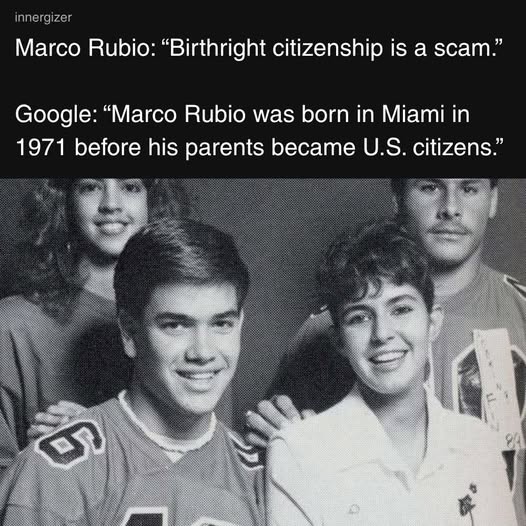
In recent days, a social media post has sparked intense debate about the origins of U.S. citizenship laws, specifically targeting Senator Marco Rubio’s status and the broader concept of birthright citizenship. An image circulating widely suggests that Rubio’s claim to U.S. citizenship is based on a technicality, stating: “Birthright citizenship is a scam.” The post further claims, “Google: Marco Rubio was born in Miami in 1971 before his parents became U.S. citizens,” implying that Rubio’s citizenship might be in question or that the system itself is being misrepresented to the public.
This narrative, however, overlooks the legal nuances of U.S. citizenship laws and the historical context of Rubio’s birth. Born in Miami in 1971, Rubio is a natural-born U.S. citizen because of the doctrine of *jus soli*, or right of the soil, which grants citizenship to anyone born on U.S. soil regardless of their parents’ nationality. The claim that Rubio’s parents were not U.S. citizens at the time of his birth is factually inaccurate — his parents became U.S. citizens after Rubio’s birth, not before, and U.S. law at the time recognized his birth as conferring automatic citizenship.
Many social media users have questioned or misrepresented the legalities surrounding Rubio’s status, possibly fueled by ongoing debates about immigration and birthright citizenship in the United States. Some opponents of the policy argue that individuals like Rubio, born on U.S. soil, should not automatically receive citizenship if their parents are not citizens. However, legal experts point out that the 14th Amendment and longstanding immigration laws have consistently affirmed that those born on U.S. soil are U.S. citizens, regardless of parental status.
Rubio, a Florida senator and a prominent figure in Republican politics, has publicly supported the idea of reforming or ending birthright citizenship, framing it as an issue of national sovereignty. Nonetheless, these social media posts seem to conflate legal citizenship with political rhetoric, disregarding the established legal framework that grants Rubio and millions of others their citizenship status from birth.
This controversy underscores a broader trend: the rising use of social media misinformation to challenge or reshape narratives about American identity and constitutional law. While it’s crucial for the public to be informed and critical, understanding the legal facts is essential to avoid misconceptions that can distort public discourse.
In sum, the claim that Rubio’s citizenship is a “scam” based on his birthplace is not supported by the current legal standards. Rubio was born in Miami, making him a natural-born U.S. citizen under constitutional law. The debate over birthright citizenship remains complex and politically charged, but it’s important to distinguish between legal facts and misinformation spread for political purposes.
Where to Learn More
- U.S. Constitution, 14th Amendment – Cornell Law School
- The 14th Amendment and Birthright Citizenship – U.S. Senate
- The Continuing Debate Over Birthright Citizenship – The Heritage Foundation