
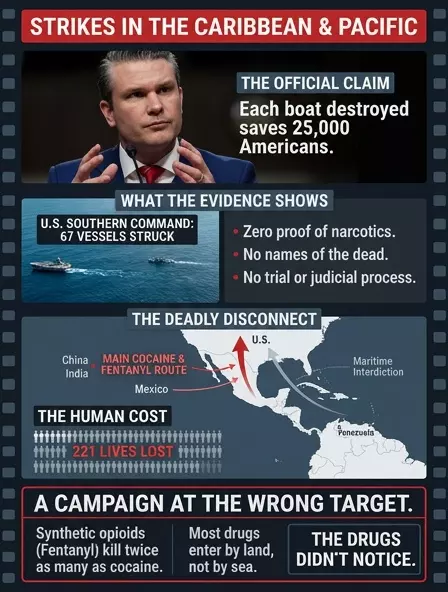
The U.S. military’s recent campaign targeting boats in the Caribbean and Pacific has come under intense scrutiny after new evidence suggests it has killed at least 221 people since September, with no confirmed links to drug trafficking or evidence that the strikes have curbed drug flow into the United States.
Beginning on September 2 off the coast of Venezuela, the U.S. Southern Command launched a series of drone and missile strikes against what they labeled as “narco-trafficking routes.” To date, at least 67 vessels have been destroyed in this operation. Each strike is accompanied by grainy videos of boats exploding and statements claiming the targets were involved in drug trafficking. However, critics and human rights advocates point out that the government offers no concrete evidence supporting these claims.
Despite the reported destruction, there has been no transparency. No evidence of drug cargos, no charges, and no judicial process. The families of those killed have received no information, and international watchdogs describe the campaign as a “killing spree.” The United Nations has condemned the strikes as “unlawful killings carried out by order of a government, without judicial or legal process,” raising serious questions about legality and human rights violations.
Former President Donald Trump, a staunch supporter of the initiative, has claimed that each boat destroyed “saves 25,000 American lives,” but evidence paints a different picture. Most cocaine destined for the U.S. does not travel via these maritime routes but instead moves overland through Mexico, where it enters the United States along the border. The crisis of addiction and overdose in the U.S. is primarily driven by synthetic opioids like fentanyl, produced mainly in Mexico and shipped from China and India — a route entirely separate from the targeted waters.
Since June 21, the campaign has been paused, with no clear explanation from the Pentagon or the Biden administration. If the operation were making a significant impact, officials would likely boast about successes, but instead, silence surrounds the pause.
This controversial series of strikes has claimed more lives than it has prevented drugs from reaching U.S. shores, critics argue. With no judicial review, no proof of narcotics, and a focus on the wrong ocean, many see the campaign as a costly, unlawful, and ineffective approach to what is clearly a land-border crisis.
As the death toll and legal questions mount, the question remains: why continue a campaign that seems to have little effect on the real sources of drug addiction and overdose? The so-called war on drugs appears to be ignoring the facts — the drugs most lethal to Americans rarely travel on the routes being bombed.
Where to Learn More
- U.S. Drone Strikes in Caribbean and Pacific Raise Human Rights Concerns – Amnesty International
- UN Condemns U.S. Strikes as Unlawful Killings – United Nations
- The Drug War’s Real Targets and Why It Fails – The New York Times
- Fact-Checking the U.S. Military’s Anti-Drug Operations – The Washington Post