
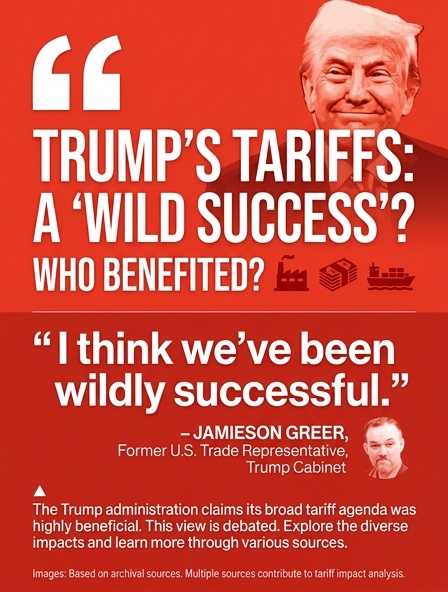
In recent weeks, a bold claim from a key member of former President Donald Trump’s economic team has sparked widespread debate: “We’ve been wildly successful,” declared Jamieson Greer, who served as a U.S. Trade Representative in Trump’s cabinet. However, the reality behind these tariffs paints a far more complex picture, especially for small business owners and everyday American consumers.
During Trump’s tenure, the administration implemented a series of aggressive tariffs, notably on Chinese imports, under the guise of protecting American jobs and manufacturing. The White House insisted these measures would revitalize domestic industries and rebalance international trade. Yet, recent analyses suggest otherwise, revealing a narrative of uneven benefits.
An eye-opening infographic from the Center for American Progress (CAP) exposes the outsized gains for certain sectors, primarily multinational corporations and wealthy shareholders. While large firms that rely on imported raw materials or intermediate goods have sometimes seen temporary relief, small businesses and consumers often shoulder the burden.
Consider the everyday American shopper: tariffs on imported electronics, clothing, and machinery have resulted in higher prices and fewer choices. Small retailers, often operating on thin margins, struggle to absorb cost hikes. According to CAP data, many small business owners report declining sales due to inflated supply costs, forcing some to cut jobs or shutter storefronts entirely.
Moreover, workers in sectors without substantial protections are left vulnerable. Despite Trump’s promises to bolster American manufacturing, the tariffs have, in some cases, led to trade retaliations and supply chain disruptions. The result is a mixed bag of outcomes—while some large companies enjoy windfalls, many workers and small businesses find themselves squeezed.
The quote from Greer, suggesting success on a broad scale, ignores the nuanced realities faced by the vast majority of Americans. For many small business owners and consumers, the tariffs are less of a victory and more of a hurdle, leading to higher prices and economic uncertainty.
Economists warn that such trade policies risk long-term harm to the U.S. economy by hampering growth and innovation at the grassroots level. As debates continue, the question remains: who truly benefits from these tariffs—wealthy shareholders and corporate interests, or everyday Americans?
Where to Learn More
- Trump’s Section 122 Tariffs Have Delivered Nothing for American Businesses, Workers, or Communities – Center for American Progress
- The Impact of Trump’s Tariffs on Manufacturing and Consumers – Economic Policy Institute
- Analyzing the Real Effects of Trump’s Tariffs on the U.S. Economy – The New York Times
- The Hidden Costs of Tariffs for Small Businesses – The Washington Post