
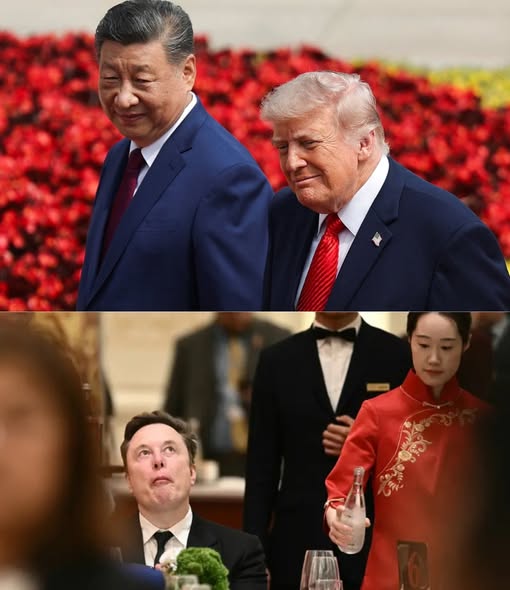
When former President Donald Trump flew to Beijing accompanied by a planeload of billionaires, many expected a high-stakes diplomatic showdown. Instead, he returned with little more than symbolic gestures, while Xi Jinping quietly maintained Beijing’s strategic grip—leaving the average American footing the bill for the spectacle.
During the trip, Trump and a parade of wealthy allies toured China’s historic sites and posed for photos that seemed more like tourist snapshots than diplomatic negotiations. Elon Musk, among other billionaires, enthusiastically filmed the Great Hall of the People and made playful faces with Apple CEO Tim Cook. Meanwhile, beneath the superficial show of camaraderie, Xi Jinping was reportedly “eating Trump’s lunch,” as analysts put it, by reinforcing Beijing’s strategic resilience and keeping key leverage quietly in Beijing’s hands.
Contrary to Trump’s vow to “make China open up,” critics argue that Beijing delivered only token gestures. Xi nodded vaguely towards buying some U.S. oil and Boeing jets—an echo of the same old script from a decade ago. Behind the scenes, strategic leverage remained firmly in China’s control, with Xi Jinping masterfully keeping the doors closed on meaningful concessions.
Yet the real cost of this diplomatic theater is felt far away from the cameras. U.S. consumers and taxpayers are shouldering the repercussions of a distorted trade relationship. The average U.S. tariff on Chinese imports now sits at a staggering 47.5 percent, skyrocketing from just 3.1 percent before Trump’s first term. This “hidden tax” is embedded in the cost of everyday items—appliances, car parts, electronics—adding hundreds if not thousands of dollars to American households annually.
Meanwhile, American farmers suffering from China’s historic decision to halt soybean purchases faced an $11 billion bailout—”a Band-Aid on a deep wound,” as one farm leader described it. Ironically, Trump quietly sent $20 billion in aid to Argentina, a major competitor to U.S. farmers, further complicating the economic fallout.
The collapse of bilateral trade underscores this disconnect. From a peak of approximately $690 billion in 2022, U.S.-China trade shrank to about $415 billion last year. Markets tumbled, supply chains fractured, and American businesses bore the brunt of the geopolitical tug-of-war. Despite the diplomatic photo ops, Xi Jinping’s calculated modesty masked a strategy that kept Beijing’s strategic tools firmly in place, showing little sign of genuine concessions or openness.
As the spectacle concludes, it’s clear that the “art of the deal” as delivered by Trump’s trip largely benefited billionaires and failed to address the economic harm faced by ordinary Americans. Instead of a meaningful breakthrough, what’s left is a reminder that who pays the price for these diplomatic gestures is, ultimately, the American middle class.
Where to Learn More
- The Real Cost of US-China Trade Tensions – CNN
- How China is Still Playing Strategic Hardball – The New York Times
- Farmers and Trade Policies: The Hidden Price – Bloomberg
- Analysis of Trump’s Beijing trip and its true impact – Politico