
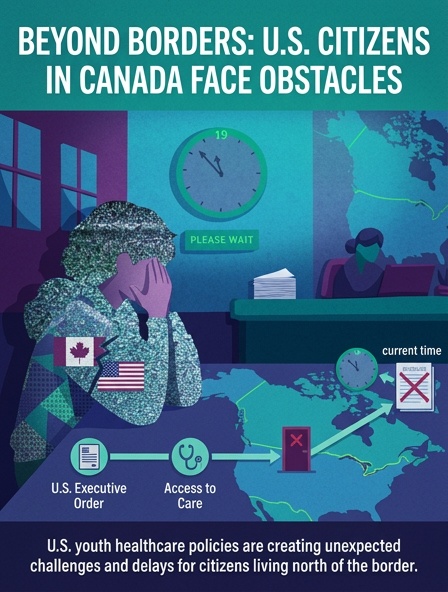
In a move that has sent ripples across the political and healthcare communities, President Donald Trump’s recent Executive Order banning gender-affirming care for individuals under 19 has captured national headlines. While this policy directly impacts American clinics and providers within the United States, a less obvious but equally complex issue is emerging among U.S. citizens living in Canada: many report facing significant obstacles to accessing gender-affirming treatments abroad, despite the policy not applying outside U.S. borders.
The Executive Order, signed earlier this year, effectively restricts federal funding and support for gender-affirming healthcare for minors in the U.S. It underscores the current administration’s stance on transgender healthcare, complicating efforts for many families seeking timely and essential treatments for their transgender children. However, this policy’s reach appears to be narrowly confined within American jurisdiction. Canadian healthcare systems—largely publicly funded and independent—do not implement or recognize the restrictions outlined by Trump’s order.
Nevertheless, U.S. expatriates and border-crossing patients in Canada are struggling with new hurdles. Many report that Canadian clinics, while legally capable of providing gender-affirming services, are increasingly hesitant to work with American patients due to legal uncertainties, insurance concerns, and the threat of U.S. federal scrutiny. Some clinics have even instituted cautious policies, requiring extensive documentation or limiting the types of care offered to foreign patients.
“I moved to Toronto two years ago to access the care I couldn’t get back home,” says Sarah Mitchell, a U.S. citizen in her twenties. “Now I find myself fighting to get hormone therapy approved at local clinics, and even then, there are added layers of paperwork and delays I didn’t face before.” Mitchell’s experience echoes a broader sentiment among U.S. expats who fear that U.S. policies are casting a shadow over their healthcare access abroad.
Experts warn that these obstacles risk creating a dual-standard for transgender youth—one in the U.S. restricted by policy and one in Canada that, while more accessible, is now encumbered by legal and logistical barriers rooted in the Trump administration’s restrictions. Healthcare advocates emphasize that timely access to gender-affirming care is vital for mental health, well-being, and human rights, regardless of national borders.
“This situation underscores the complexities that arise when policies target marginalized communities,” notes Dr. Linda Chen, a Toronto-based gender health specialist. “Even if a country’s laws are different, international patients can still be caught in the crossfire of political struggles.” She urges U.S. citizens in Canada to stay informed and work closely with local healthcare providers and legal advisors.
As the debate over transgender healthcare continues to stir politically, many in the community call for increased international cooperation and clarity to ensure that no one is left behind due to borders or policies. While the executive order may have limited direct legal influence outside the U.S., the ripple effects threaten to disrupt the lives of those seeking essential, lifesaving care across borders.
Where to Learn More
- U.S. Expats Face Hurdles to Gender-Affirming Care in Canada Amid U.S. Policy Restrictions – NBC News
- Canadian Healthcare Responds to Rising Demand for Transgender Services – The Globe and Mail
- Human Rights Campaign: Impact of U.S. Policies on Trans Communities Abroad
- Health Canada: Transgender Health Services and Resources