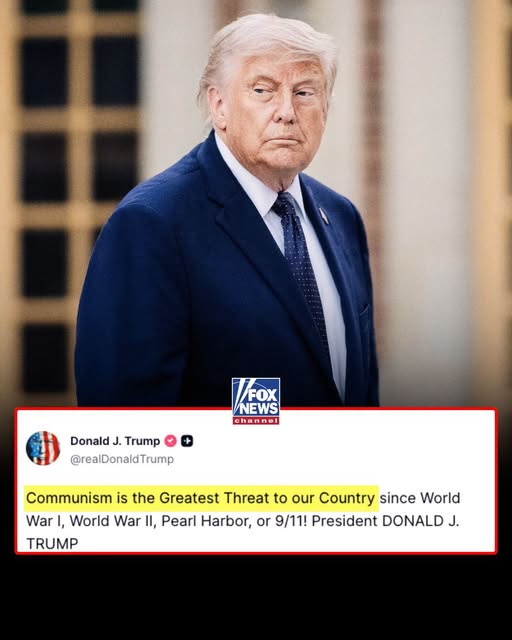
In a fiery escalation of his recent rhetoric, former President Donald Trump has issued stark warnings arguing that “Communism is the greatest threat to our country since World War I, World War II, Pearl Harbor, or 9/11.” His comments come amidst a tense political climate marked by high-profile victories for socialist Democrats in recent primary elections, notably in New York.
Just days after the primary results, Trump took to social media to express his concerns about the ideological direction of the nation, framing the political left’s recent successes as evidence of a dangerous shift towards socialism. In a post that has since gone viral, Trump stated, “Communism is the greatest threat to our country since WWII, Pearl Harbor, or 9/11!” This provocative comparison underscores his belief that the ideological battles of today are as critical as the most defining moments in American history.
The former president didn’t stop there. In another post, Trump singled out Washington, D.C., mayoral candidate Janeese Lewis George, labeling her a “communist” and vowing to prevent her influences from shaping the nation’s capital. “I will not allow D.C. to be destroyed by radical leftist policies,” Trump declared, asserting his commitment to “protect the soul of America from socialist infiltration.” These words resonate with his base, emphasizing a narrative that portrays the political left as a communist threat to American values and freedoms.
Experts note that Trump’s rhetoric taps into longstanding fears about socialism and communism, particularly among conservative voters who view such ideologies as antithetical to American democracy and capitalism. His framing of recent political events as existential threats aims to energize his supporters ahead of upcoming elections, positioning himself as the defender of patriotic American ideals against what he portrays as a dangerous socialist agenda.
Political analysts also observe that Trump’s recent comments coincide with a broader strategy to rally his base by framing the opposition not just as political rivals but as existential threats to national security. Critics argue that such rhetoric can deepen partisan divides and escalate tensions, especially when conflating socialism with communism and equating political opponents with American enemies.
Meanwhile, Democrats and moderates stress the importance of nuanced political discourse. They argue that labeling political opponents as enemies or threats fosters division and undermines democratic dialogue. Leaders from across the spectrum warn against the dangers of spreading fear-based narratives, emphasizing the need for constructive discussion and understanding amidst a polarized political environment.
As the nation prepares for future elections, the intensity of rhetoric surrounding ideological threats underscores the ongoing battle over America’s political identity. Whether this rhetoric will mobilize voters or further deepen divisions remains to be seen, but one thing is clear: discussions on socialism, communism, and national security are at the forefront of America’s political conversation.
Where to Learn More
- Trump Warns of Communism, Frames it as Major Threat to U.S. Safety – The New York Times
- Analysis: Trump’s Rhetoric Shifts Focus to Ideological War – The Washington Post
- Trump Labels D.C. Mayoral Candidate a “Communist,” Vows to Protect Capital – Politico
- U.S. Political Rhetoric and the Fight Against Socialism – BBC News