
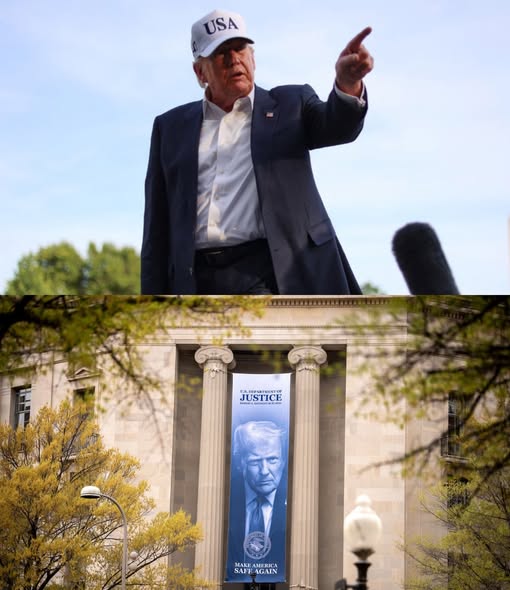
In what some are calling the most brazen act of presidential self-dealing in American history, former President Donald Trump has orchestrated a scheme to transfer nearly $1.8 billion from the U.S. Treasury—funds that were never authorized by Congress—to pay his loyalists and allies.
The controversy centers around a series of covert actions that unfolded in January, culminating in a controversial deal that has ignited outrage across the political spectrum. It all began when Trump and his sons filed a $10 billion lawsuit against the Internal Revenue Service (IRS), accusing the agency of leaking his tax returns from the 2020 tax year. This high-stakes legal challenge was set to be decided by a federal judge—a case that posed a serious constitutional question: can a sitting president sue the government he leads?
Just two days before that decision, the Department of Justice (DOJ), led by Acting Attorney General Todd Blanche—Trump’s former criminal defense lawyer—shocked observers by abruptly dropping the lawsuit. In exchange, the DOJ established a secret fund known as the “Anti-Weaponization Fund”, funneling a staggering $1.776 billion directly from the Treasury’s Judgment Fund—money that had never been appropriated by Congress, nor approved by elected representatives.
This fund, according to internal disclosures, is overseen by a five-member commission hand-picked by the Attorney General and arguably accountable solely to Trump—since the President can remove members at will. Disturbingly, the criteria for disbursing payments include January 6 defendants and Trump allies with grievances against Biden, effectively creating a slush fund for politically motivated payouts. The commission reports only to Blanche, bypassing congressional oversight entirely.
What makes the situation even more scandalous is Trump’s own absence from the list of recipients. While he is ineligible to receive direct payments, he is slated for a formal government apology and is expected to drop separate legal claims over issues such as the Mar-a-Lago search and the Russia investigation—conditions tied to the transfer of taxpayer dollars. Meanwhile, his friends, associates, and potentially violent extremists who participated in the Capitol riot are positioned to benefit financially.
Legislatively, the move has been strongly condemned. Rep. Jamie Raskin described the “Anti-Weaponization Fund” as a slush fund for Trump’s “private militia of insurrectionists, rioters, and white supremacists.” Democracy Forward, a nonprofit legal organization, called the entire arrangement a sham designed solely to “launder taxpayer money” for partisan interests.
Never before has a sitting president extracted a billion-dollar settlement from the government of which he is still technically part. The implications threaten to undermine the very foundations of American democracy, transforming taxpayer dollars into political weapons and personal paychecks.
The irony is bitter: the law enforcement officers who bravely defended the Capitol on January 6 are now, in a twist worthy of dystopian fiction, bearing the financial burden—and some argue, the punishment—at the hands of those they fought to stop.
Where to Learn More
- NYTimes: Explainer on the Trump DOJ fund scandal – The New York Times
- Washington Post: Inside the Creation of the $1.776 Billion Slush Fund – The Washington Post
- Democracy Forward: Analysis of the Anti-Weaponization Fund
- Politico: The Unprecedented Nature of Trump’s Legal Settlement
- CNN: Legal and Political Repercussions of the Scandal