
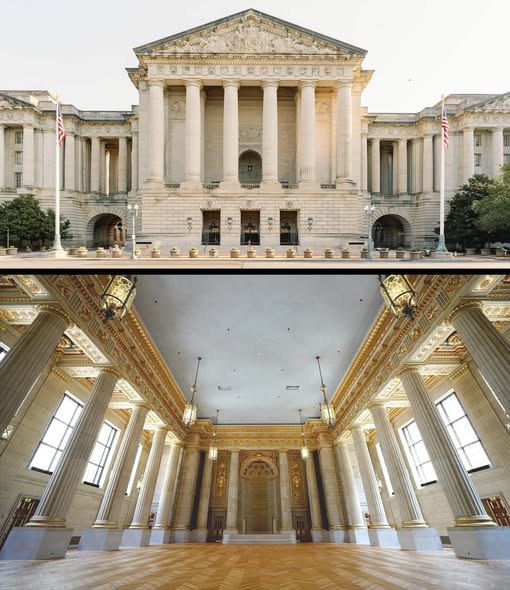
In an era marked by political turbulence and shifting priorities, a new controversy has emerged surrounding former President Donald Trump’s lavish spending on a presidential ballroom—despite the existence of a stunning government-owned venue just a mile from the White House.
The Andrew W. Mellon Memorial Auditorium stands as an architectural marvel on Constitution Avenue. With its gilded friezes, soaring 60-foot ceilings, and dazzling chandeliers, the auditorium has historically hosted significant events, such as the signing of the NATO treaty in 1949 and numerous presidential inaugural balls. Capable of accommodating up to 1,000 guests, it has been a symbol of grandeur and diplomatic importance. Moreover, as a federally owned facility, it represents a historical asset, maintained by taxpayers’ dollars and already suited for high-profile functions.
Yet, despite this, former President Trump has prioritized demolishing part of the White House—its East Wing—for a new, extravagant ballroom that has ballooned from an initial estimate of $200 million to a staggering $1 billion congressional funding request. This raises eyebrows and questions about the true motivations behind such an unprecedented investment.
Officially, the rationale is that hosting world leaders “under a lawn tent” is unbefitting of America’s diplomatic stature. While there’s truth in the prestige a dedicated ballroom offers, critics argue that the existing Mellon Auditorium already fulfills this role adequately. The venue’s history of hosting world leaders, state dinners, and significant summits demonstrates its suitability and readiness to serve presidential needs.
So why then, is there such an emphasis on building a new, private hall? A compelling, if troubling, perspective suggests that this push for a new ballroom is about legacy—more specifically, creating a physical monument to Trump himself at a time when he feels his influence is waning. In essence, it’s about leaving a lasting mark, a “Trump monument” in the form of a grand architectural addition, amidst ongoing reconstructive changes to the White House’s interior—the Rose Garden, the Oval Office, and the East Wing—all increasingly customized in his image.
Many political analysts argue this project is less about practicality and more about permanence. With no forthcoming national monument or memorial in his honor, critics posit that Trump is attempting to craft his legacy through these architectural endeavors, securing a physical footprint in the nation’s capital that outlasts his presidency. It’s a highly visible statement—an assertion of influence designed to endure, perhaps, long after he’s left office.
In the end, the question remains: Why spend a billion dollars on a new ballroom when such a magnificent existing venue already exists? The answer, critics say, lies in a desire for personal legacy rather than public necessity. As public funds go toward this high-cost project, many wonder whether it represents a prudent investment or an act of self-aggrandizement—an architectural monument to political ego in a city already rich with history and symbolism.
Where to Learn More
- The True Cost of Trump’s White House Renovations – Washington Post
- Why Trump’s Billion-Dollar Ballroom Is Causing a Stir – The New York Times
- Analyzing Trump’s Quest for Lasting Legacy Through Architecture – CNN
- The Politics of Architectural Mark-Making in Washington – BBC News