
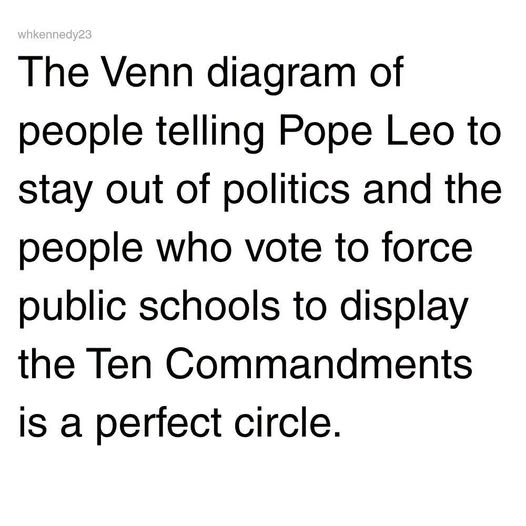
In the tangled web of American political and religious discourse, a recent social media post has sparked widespread debate and amusement. The image features a Venn diagram illustrating a surprising overlap: the set of people repeatedly telling Pope Leo to “stay out of politics” appears to significantly intersect with those voting to require public schools to display the Ten Commandments. The caption humorously notes that this intersection forms a curious “Venn diagram,” highlighting the contradictory nature of some public stance shifts on religion and politics.
This social media topic taps into a broader conversation about the evolving boundaries of church and state in the United States. On one side, many individuals advocate for the separation of church and state, emphasizing religious neutrality in public institutions. On the other, there are voters and activists pushing for the reinforcement of Christian symbols and commandments in government and educational settings, often under the guise of fostering moral values.
The controversy comes to a head with legal battles and school board policies that attempt to display religious texts and symbols. The Ten Commandments, rooted in Judeo-Christian tradition, have been at the center of debates for decades, especially concerning their display in courthouses and schools. Critics argue such displays violate the Establishment Clause of the First Amendment, which prohibits government endorsement of religion. Supporters, however, claim they serve as a cultural touchstone and moral foundation.
The social media post humorously suggests that many people who loudly demand religious neutrality—”stay out of politics”—are often the same individuals advocating for religious displays in public spaces. This raises questions about consistency and motives in the political landscape. Are these calls for neutrality genuine, or are they selectively applied based on cultural identity and beliefs?
Data from polling organizations show that public opinion on religion in public institutions varies widely across the political spectrum. While some see religious symbols as an integral part of American heritage, court rulings and legal precedents assert that for religious symbols to be displayed publicly, they must meet strict criteria of neutrality and secular purpose.
The humor and irony in the Venn diagram capture the complexity and sometimes contradictory nature of civic debates surrounding religion, morality, and public policy. It serves as a reminder that the boundaries between religious expression and secular governance are often murky, and public opinion can oscillate depending on political climate and cultural pressures.
As debates continue, many legal experts and civics advocates emphasize the importance of balancing religious freedom with the need for government to remain neutral. This social media meme sheds light on the inconsistent priorities in these discussions and invites viewers to reflect on their own positions regarding religion and politics in America.