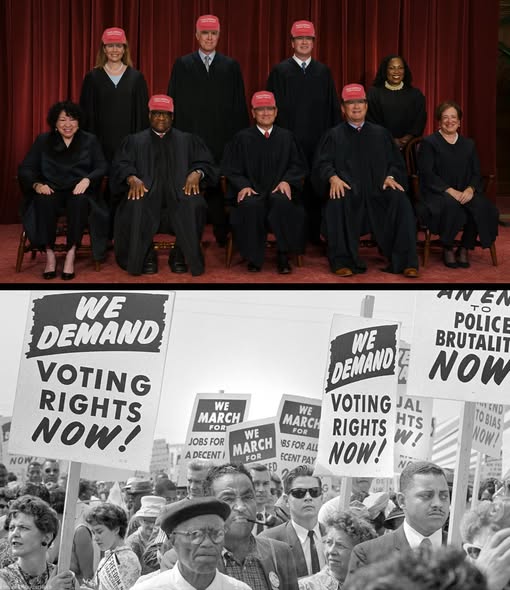
The Supreme Court delivered a seismic blow to voting rights today, ruling 6-3 in Louisiana v. Callais that effectively guts Section 2 of the Voting Rights Act, a landmark law that for decades helped dismantle Jim Crow-era discrimination and paved the way for fair electoral representation for communities of color.
At the center of this contentious decision is Justice Samuel Alito, whose majority opinion fundamentally redefines the legal standards for prosecuting racial discrimination in voting. The new interpretation allows politicians to draw electoral maps that dilute the power of voters of color, as long as they label their actions as “partisan” rather than racially motivated. In essence, this ruling gives partisan gerrymandering a green light, transforming it into a shield against racial discrimination claims.
The stakes couldn’t be higher. Voting rights advocates warn that this decision could enable states to redraw districts with impunity, potentially adding as many as 19 extra Republican-held House seats in the 2024 elections. States like Florida, Alabama, and South Carolina are already eyeing the ruling as a green light to implement more aggressive gerrymandering strategies that favor partisan advantage over fairness.
The consequences are unsettling. The NAACP Legal Defense Fund issued a sharp statement, warning that states can now “discriminate with impunity,” effectively removing a critical safeguard against racial and partisan manipulation of voting districts. This erosion of protections raises fears that the political playing field is shifting dangerously in favor of those looking to entrench power, regardless of the voices of marginalized communities.
The timing of the ruling is particularly notable. On the very same day, Florida’s legislature passed a new congressional map explicitly designed to maximize Republican advantages. Meanwhile, the Biden administration is pushing to eliminate temporary protections for millions of immigrants—decidedly a move seen by some as a broader retreat from federal safeguards and a weakening of democratic norms.
Voting rights advocates and civil rights groups are voicing urgent concern. They warn that the “guardrail” that once prevented discriminatory districting is gone, leaving the future of fair elections uncertain. As one activist succinctly put it, “What comes next is anyone’s guess, and that is the real problem.”
This ruling could reshape American electoral politics for years to come, with profound impacts on representation, racial equity, and the health of democracy itself. While the legal landscape shifts, one thing is clear: the fight to protect voting rights is far from over.