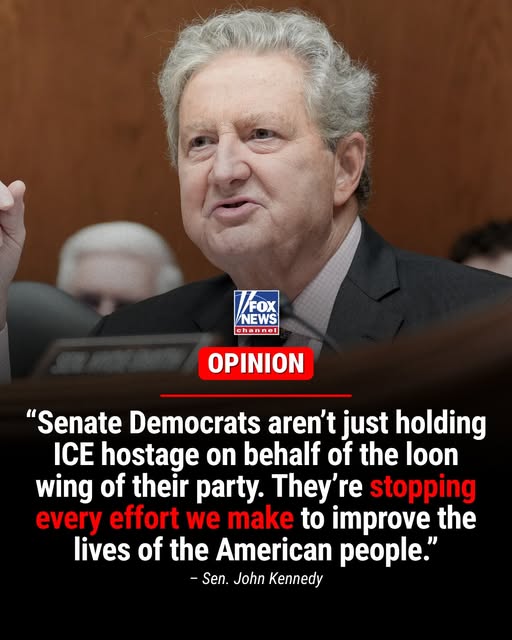
In a fiery critique that’s resonating across political circles, Senator John Kennedy (R-Louisiana) has sharply condemned the Democratic Party’s handling of Immigration and Customs Enforcement (ICE) funding, accusing them of wielding an “allergy to common-sense policies.” Speaking out amidst ongoing budget negotiations, Kennedy argued that the Democrats’ shift to prioritize ideological extremes has effectively hamstrung efforts to ensure ICE agents are paid and operational.
Kennedy’s remarks pinpoint what he calls the growing influence of what he refers to as the “loon wing” of the Democratic Party — a faction he claims is steering party policy further away from pragmatic immigration enforcement. “*They’re holding ICE hostage on behalf of their most extreme wing,*” Kennedy stated during a recent interview, emphasizing that this ideological radicalism is creating chaos within the federal immigration enforcement machinery.
The Louisiana senator articulated his frustration that this faction’s influence is forcing GOP lawmakers into a difficult position. With Democrats seemingly unwilling to compromise on immigration policies, Republicans are left with limited options to fund critical agencies like ICE. According to Kennedy, the GOP is turning to the budget reconciliation process — a legislative maneuver that allows for bypassing the filibuster — to secure necessary funding for ICE agents.
This heated debate comes amidst a broader political climate where immigration enforcement remains a contentious issue. For many Republicans, robust immigration policies are essential for border security, economic stability, and national safety. However, Democrats have often opposed such measures, instead emphasizing reforms aimed at more lenient immigration policies and humane treatment options.
A recent social media post, which has gone viral, highlights Kennedy’s stance by quoting a Fox News opinion piece stating, “*Senate Democrats aren’t just holding ICE hostage on behalf of the loon wing of their party. They’re stopping every effort we make to fund and support ICE agents.*” This reflects the sharp partisan divides over immigration policies and the funding that sustains enforcement agencies.
As negotiations continue, many observers see this as yet another example of how ideological extremism on both sides is complicating legislative progress. Kennedy’s comments underscore a persistent GOP narrative that Democrats are increasingly influenced by their more radical factions, leaving less room for bipartisan solutions — especially on critical issues like immigration enforcement.
While some critics argue that this framing simplifies complex policy disagreements, Kennedy’s vocal opposition underscores a broader push within the GOP to push fiscal and immigration policies through unconventional legislative tactics. The question remains whether this approach will succeed in securing funding or if it will deepen the partisan stalemate.