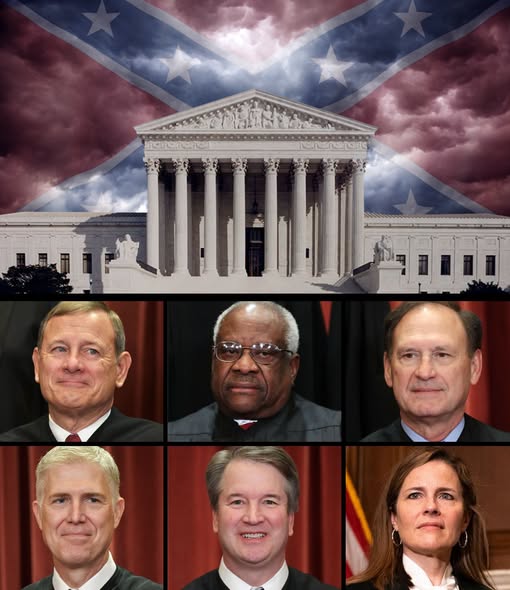
The Supreme Court delivered a monumental, yet controversial, victory for the Trump administration last week, upholding significant restrictions on immigration policies that affect hundreds of thousands of vulnerable individuals. In a 6-3 ruling along party lines, the conservative justices affirmed that the government could revoke Temporary Protected Status (TPS) for over 350,000 Haitians and thousands of Syrians, while allowing border agents to turn away asylum seekers *before* they even set foot on American soil.
What has ignited fierce backlash is not just the substance of the rulings but the court’s conspicuous silence regarding the language used by former President Donald Trump—words many see as racist and dehumanizing—that the majority simply refused to print in their official opinion.
Justice Elena Kagan, in a pointed dissent joined by Justices Sonia Sotomayor and Ketanji Jackson, highlighted this omission: “The Court declines to quote President Trump’s own repellent and racially inflected words, which are so offensive that the majority chooses not to put them in print.” She then proceeded to explicitly include Trump’s offensive remarks, listing his infamous descriptions of Haiti as a “sh!thole country,” accusations that Haitians in Ohio eat pets, and his racist claim that Haitians “probably have AIDS.” Kagan also cited Trump’s statement that Haitians and other minorities were “poisoning the blood” of the United States—comments steeped in racial stereotypes and tropes.
In her opinion, Kagan emphasized that these references “of filth, disease, and primitiveness” are directly laced with racial stereotypes, and noted the conspicuous absence of these words in the official court papers, describing it as a blatant sidestepping of the real issue: the racial underpinnings of the policy decisions upheld by the Court.
The majority’s rationalization, that the rulings were not “overtly racial,” did little to conceal their dissonance with the stark reality that the decisions—supported by dry legal language—are rooted in policies that disproportionately target communities of color. The court’s refusal to acknowledge the racist language from Trump himself, even as justices like Kagan laid it bare, has only intensified allegations that the judiciary is turning a blind eye to racial injustice.
Many observers see this as yet another chapter in the ongoing saga of the Supreme Court quietly condoning policies and rhetoric that perpetuate racial disparities, all under the guise of legal technicalities. The dissent’s refusal to stay silent on Trump’s words underscores the importance of confronting uncomfortable truths, especially when the highest court in the land effectively omits them from the record.
As critics denounce the rulings and the court’s silence, the broader conversation about racial bias and systemic injustice in the legal system continues to escalate. The court’s silence, critics argue, is a form of complicity—one that may have far-reaching implications for immigrant communities and racial justice in America.
Where to Learn More
- Supreme Court Rules on Immigration Policies Amid Controversy Over Racial Language – The New York Times
- Justice Kagan Slams Court’s Silence on Trump’s Racial Remarks in Immigration Case – The Washington Post
- The Supreme Court’s Failings on Race and Immigration – The Nation
- Analysis: How the Supreme Court’s Ruling Upholds Racially Charged Immigration Policies – Al Jazeera