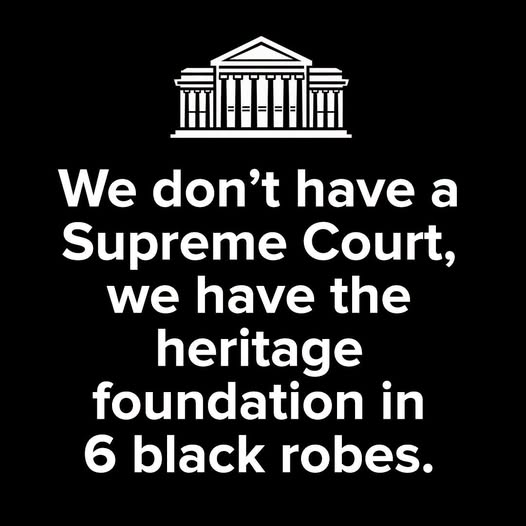
In recent days, a provocative social media image has ignited a flurry of discussions across platforms about the true nature of the U.S. Supreme Court. The image, which boldly states, “We don’t have a Supreme Court, we have the Heritage Foundation in 6 black robes,” has struck a chord—and controversy—among critics and supporters alike.
This statement reflects a growing concern among some critics that the judiciary, particularly the high court, has become overly influenced by conservative think tanks, most notably the Heritage Foundation. Founded in 1973, the Heritage Foundation is a prominent conservative think tank known for shaping policy and judicial philosophies aligned with its ideological leanings.
Many interpret the image as hyperbolic but symbolic, suggesting that the Supreme Court’s ruling patterns and judicial philosophies increasingly mirror the policy positions of the Heritage Foundation, rather than being independent arbiters of the law. Critics argue that this perceived alignment undermines the principle of an impartial judiciary, raising questions about the separation of powers and the influence of partisan and ideological organizations within our justice system.
Supporters, however, defend the Court’s decisions, emphasizing the importance of ideological consistency in maintaining judicial integrity. They argue that the influence of think tanks like Heritage is part of a broader ideological movement within conservative legal circles, which has historically sought to reshape the judiciary to reflect certain constitutional philosophies.
The controversy taps into a larger national debate over the role of judicial activism versus restraint, as well as concerns over whether the Court is truly an independent body or swayed by external ideological groups. Recent decisions on issues such as environmental regulation, reproductive rights, and gun control have only heightened these perceptions, with critics claiming the Court’s ideological leanings seem increasingly aligned with conservative think tank agendas.
This social media outcry encapsulates a broader dissatisfaction among some sections of the public who see judicial impartiality as vital to maintaining the country’s democratic foundations. While the Supreme Court has always been a subject of heated debate, this latest controversy underscores the importance—and challenge—of ensuring judicial independence in an increasingly polarized political climate.
As the debate continues to trend online, it serves as a reminder of the importance of transparency and accountability within the judiciary, and the ongoing conversation about what truly constitutes an unbiased and independent judicial system in America.
Where to Learn More
- How Think Tanks Influence the Supreme Court – CNN
- The Rise of Ideological Think Tanks and Their Impact on the Judiciary – The New York Times
- Inside the Heritage Foundation’s Effort to Shape Judicial Outcomes – ProPublica
- SCOTUSblog – In-depth Analysis of Supreme Court Cases
- Brennan Center for Justice – Judicial Independence & Reform