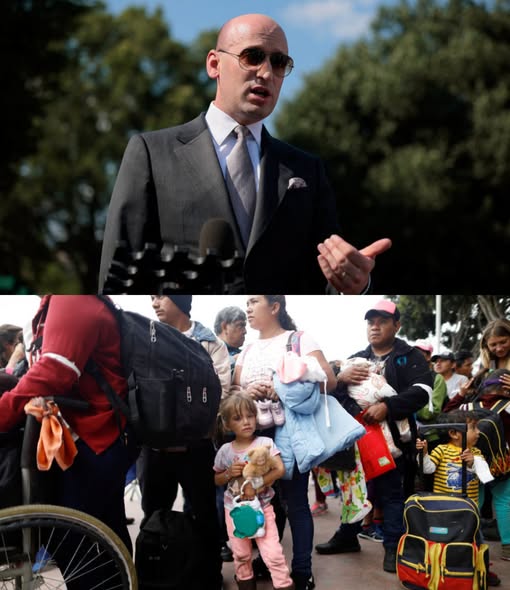
This week, former Trump advisor Stephen Miller took center stage in a wave of controversy, delivering a speech that painted a starkly unwelcoming picture of America’s immigration policies. Standing at a podium, Miller declared that the nation’s doors are “closed fully” to people fleeing danger and hardship, dismissing their pleas with harsh words and radical plans.
He told reporters that every family at the border is “lying,” dismissing the plight of desperate mothers and children by calling them “criminals” and “welfare seekers.” Arguing that turning these families away is an act of “kindness,” Miller’s words on camera froze the boundaries of compassion and humanity, sparking outrage across political and human rights communities.
But behind the stark rhetoric lies an alarming shift in policy and legal interpretation. What many may not have known is that Miller’s influence extends into deeply controversial policies affecting disabled Americans. Just days before his border remarks, Miller pushed a secretive plan—hidden in a Justice Department memo—to allow states to relegate disabled individuals back into institutional care, potentially disregarding federal protections designed to keep them in their own homes.
The law, rooted in decades of civil rights progress, clearly states that if a disabled person can live independently with some assistance, they are entitled to do so — a principle grounded in the Supreme Court ruling that such discriminatory practices amount to illegal discrimination. However, Miller and his allies have quietly worked to undermine that law. The memo openly admits courts have rejected such policies but claims states can ignore these rulings at their discretion.
The starkly economic contrast between institutionalization and supporting independent living sums up the cruelty behind this push. Keeping a disabled person in their own home averages around $17,000 annually, versus roughly $54,000 for institutional care—three times as much and significantly less humane.
This isn’t traditional Republican policy. Historically, administrations from President Trump’s first term through previous presidents upheld the protections that keep disabled Americans in their communities. The radical shift in the Miller-era approach is largely attributed to who is in the room shaping these decisions. Critics argue that his influence has prioritized cost-cutting and institutionalization over compassion and legal protections.
When news outlets like Bloomberg reported Miller’s involvement in drafting the memo, the White House swiftly denied his participation, claiming “Stephen was not involved.” Yet, critics argue that Miller’s influence is unmistakable—especially after his recent declaration that locking people out of the country is “the most humanitarian thing America could do.”
From a refugee mother at the border to a disabled child in Ohio, Miller seems to see their fate as a matter of policy choice—deciding who gets to stay in their own beds and who is forcibly moved into institutional care. His office’s repeated refrain, “He was never in the room,” echoes the troubling reality of opaque policymaking behind these harsh policies.
In a nation built on principles of compassion and inclusion, Miller’s aggressive rhetoric and policies threaten to undermine decades of progress — painting a stark portrait of an administration that’s willing to sacrifice vulnerable populations at the altar of political ideology and fiscal austerity.