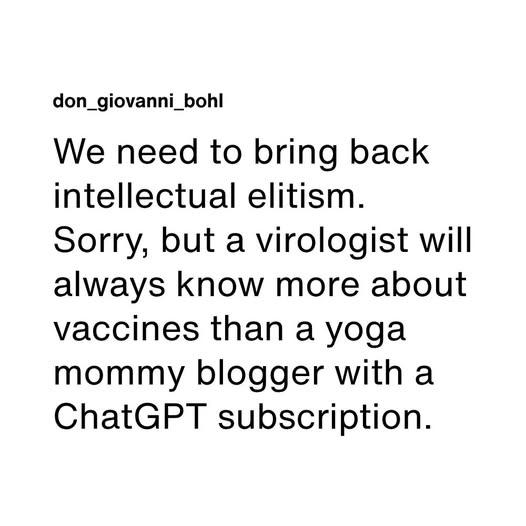
In recent weeks, a social media post has reignited a heated debate about the value of intellectual elitism in today’s information landscape. The message, from user don_giovanni_bohl, boldly states: “We need to bring back intellectual elitism. Sorry, but a virologist will always know more about vaccines than a yoga mommy blogger with a ChatGPT.”
This provocative statement has quickly gone viral, drawing both applause and backlash across platforms like Twitter and Facebook. Supporters argue that specialized expertise must be prioritized, especially in critical fields like medicine and science, to combat misinformation and protect public health. Meanwhile, critics claim that such a stance risks alienating the general public and perpetuating elitism that could deepen societal divides.
The core argument derives from the observation that today’s communication channels often blur the lines between expert knowledge and lay opinions. While democratization of information through the internet has empowered individuals to learn independently, it has also led to a proliferation of unverified advice, conspiracy theories, and pseudo-experts.
Proponents of intellectual elitism advocate for a balanced approach—respecting specialized knowledge while fostering public engagement. They contend that experts such as virologists, climatologists, and scientists should be trusted sources, especially when informing policy decisions during crises like the COVID-19 pandemic or climate change debates.
Conversely, opponents warn that elevating a perceived intellectual hierarchy can foster arrogance and dismiss the perspectives of non-experts, such as teachers, journalists, or community activists. They argue that a more inclusive dialogue, emphasizing scientific literacy rather than elitism, is crucial in promoting understanding and consensus.
Notably, the conversation also touches on the role of AI and social media algorithms, which can amplify sensationalist voices over nuanced expertise. The rise of ChatGPT and other AI tools has democratized information access, yet it also raises concerns about quality control and the potential for misinformation to spread unchecked.
As the debate continues, experts emphasize the importance of critical thinking, scientific literacy, and respectful discourse. “Intellectual elitism shouldn’t be about dismissing others,” says Dr. Emily Nguyen, a science communication specialist. “It should be about nurturing a culture that values expertise and learning, while remaining open to dialogue.”
In an era where misinformation can influence elections, health policies, and societal trust, striking the right balance between expertise and inclusivity remains a central challenge. Encouragingly, ongoing efforts are underway to improve public understanding of complex issues and to foster respect across different knowledge domains.
Where to Learn More
- The Role of Scientific Communication in Combating Misinformation – The New York Times
- AI and Misinformation: Navigating the New Knowledge Landscape – The Washington Post
- Why Scientific Literacy Matters in the Age of Social Media – Nature
- Experts vs. Laypeople: Bridging the Gap in Science Communication – The Guardian