
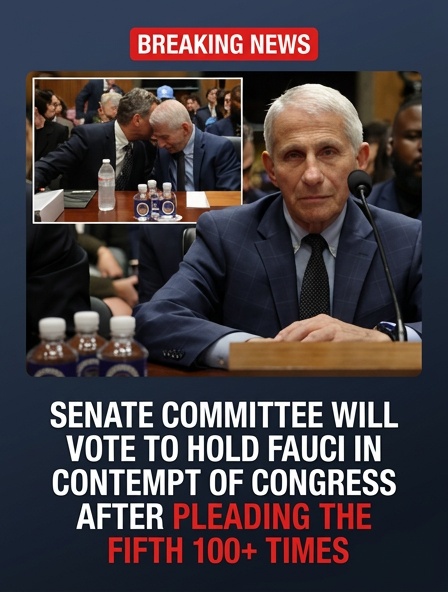
The tension between government investigators and Dr. Anthony Fauci escalates as the Senate Homeland Security and Governmental Affairs Committee prepares to hold a pivotal vote next week on whether to hold the longtime COVID-19 adviser in contempt of Congress. The move follows Fauci’s refusal to answer lawmakers’ questions during a recent hearing, citing the Fifth Amendment an astonishing 111 times, a decision that has sparked widespread debate and political fallout.
Senator Rand Paul, a prominent voice in the investigation, announced on social media that the committee plans to vote on a resolution to certify Fauci for contempt after he declined to provide answers on several critical issues. Paul emphasized that Fauci’s blanket invocation of the Fifth Amendment, particularly given the pardon he received from former President Joe Biden earlier this year, undermines his claims of privilege. “Because you refuse to answer, citing a privilege that is unsupported by law, this committee has scheduled a vote next week on a resolution certifying your contempt,” Paul stated publicly.
The controversy centers around Fauci’s repeated refusal to testify about specific details related to the origins of COVID-19, his handling of pandemic policies, and his involvement in certain grant decisions. Fauci has argued that his responses could potentially expose him to legal jeopardy, despite his previous statements asserting transparency.
The context of Fauci’s actions is complex. In May, President Biden issued a pardon for Fauci on certain matters, asserting that it protected him from possible prosecutions related to his official conduct. However, legal analysts are debating whether such a pardon extends to the use of the Fifth Amendment to refuse answering questions about official acts—especially when those acts are central to congressional oversight investigations.
The upcoming Senate vote is seen as a significant test of congressional authority and oversight, highlighting ongoing political tensions surrounding the COVID-19 pandemic and government transparency efforts. Critics argue that Fauci’s refusal to testify hampers accountability, while supporters claim he’s exercising his legal rights in a contentious political environment.
In the broader political landscape, the move to hold Fauci in contempt is likely to intensify partisan debates, with some viewing it as a necessary step toward transparency and others criticizing it as an overreach of Congressional power. The vote could set a precedent for how government officials invoke legal privileges in hearings involving sensitive or controversial matters.
The outcome of next week’s vote remains uncertain, but it signals a clear escalation in the ongoing battle between lawmakers demanding answers and Fauci’s attempts to shield himself from further scrutiny. As the country watches closely, the controversy underscores the continuing political polarization over the handling of the COVID-19 pandemic and government accountability.