
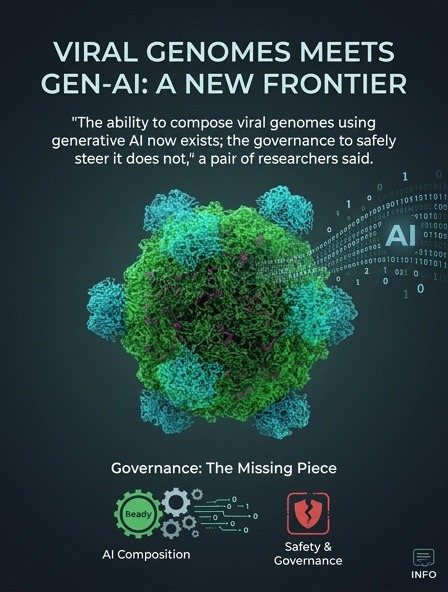
In a striking revelation during recent scientific discussions, researchers have announced that the capability to craft novel viral genomes using **generative artificial intelligence (AI)** is now a reality. While this technological leap opens exciting possibilities for vaccine development and bioengineering, it also ignites a fierce debate over the **lack of governance and safeguards** to prevent potential misuse.
Generative AI systems, traditionally lauded for creating realistic images, text, and even music, have recently been adapted to biological applications. By harnessing advanced algorithms, scientists can now design viral genomes with unprecedented precision—allowing the deliberate creation of viruses that could be used in medicine, research, or worse, bioweapons.
In a statement that has resonated throughout the scientific community, a pair of researchers emphasized the urgency of establishing **robust regulatory frameworks**. They warned, “The ability to compose viral genomes using generative AI now exists; the governance to safely steer it does not.” This stark warning highlights a critical vulnerability: while the technology is advancing rapidly, our oversight and safety measures lag behind.
Experts warn that without strict oversight, malicious actors could exploit these capabilities, either by intentionally designing dangerous pathogens or by conducting risky experiments outside ethical boundaries. The potential for bioterrorism or accidental release of engineered viruses poses profound risks to global public health and security.
Historically, bioengineering has been tightly regulated, but the democratization of AI tools has lowered barriers significantly. Now, individuals with minimal expertise could, in theory, use publicly available AI models to generate harmful viral sequences, raising alarms about “biohacking” in unregulated settings.
Several international organizations and bioethicists are calling for urgent action. Proposed measures include setting global standards for the use of AI in biological research, developing secure platforms that verify and monitor genome design processes, and increasing transparency among developers and researchers. However, implementing such safeguards on a global scale remains a formidable challenge.
This breakthrough underscores the broader debate surrounding **AI governance in the life sciences**. While AI has the potential to revolutionize medicine—leading to faster vaccine development and personalized treatments—the same technologies carry inherent risks if not properly managed.
As the conversation evolves, stakeholders from governments, academia, and industry are urged to collaborate proactively. Establishing “ethics-first” guidelines may help harness the positive potential of AI while mitigating dangerous outcomes. The future of biotechnology, researchers warn, hinges not just on technological innovations but also on the collective responsibility to regulate them wisely.
Where to Learn More
- Navigating the Ethical Challenges of AI-Driven Genome Design – Nature
- AI and Biosecurity: Managing Risks in the Age of Rapid Genome Engineering – Scientific American
- WHO Calls for International Standards on AI in Biological Research – World Health Organization
- The Risks of AI-Generated Viruses: A Wake-Up Call for Regulation – MIT Technology Review