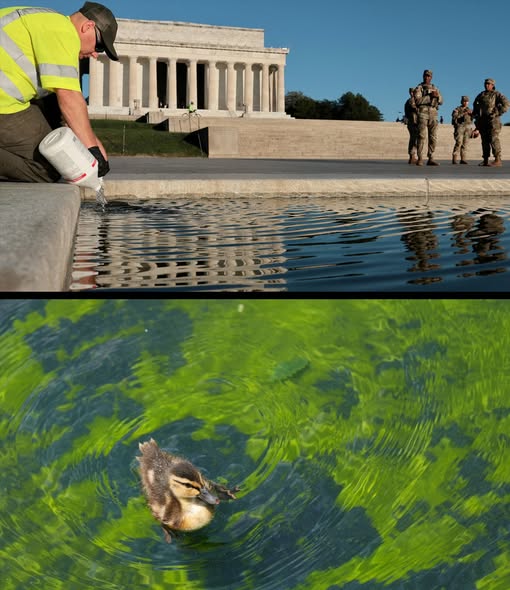
In what can only be described as a political and environmental debacle, just twelve days after the Trump administration poured a staggering $14.2 million of taxpayer money into repainting the Lincoln Memorial Reflecting Pool a patriotic “American flag blue,” workers are now frantically pouring hydrogen peroxide into the green, algae-covered waters—a spectacle that has critics calling it a national embarrassment.
The glossy blue finish, intended to symbolize national pride, has instead turned the iconic landmark into a murky swamp, reminiscent of a failed science experiment rather than a monument of honor. Experts warned from the outset that the dark blue paint’s absorption of sunlight would dramatically raise water temperatures and create perfect conditions for algae blooms. Unfortunately, their predictions proved eerily accurate.
Pool renovation expert Steve Goodale warned that the use of darker paint would inevitably lead to these problems, calling the situation a “foregone conclusion.” Yet, despite these warnings, officials pressed ahead with the costly paint job. Now, workers on their hands and knees are pouring gallons of what looks like hydrogen peroxide—obtained from Walmart pharmacy bottles—directly into the pool in an attempt to combat the algae. The method—simply dumping makeshift solutions into a 6.5 million-gallon body of water—has critics questioning whether science or common sense was sidelined in this decision.
To truly treat the water effectively, experts say, at least 8,000 liters of 12% hydrogen peroxide would need to be injected evenly throughout the pool via its filtration system. Instead, what’s happening now is akin to cleaning a bathroom with gallons of peroxide dumped at the edge, a method that offers little more than superficial coverage. As one medical professional quipped on social media, “Is this what happens when you have zero scientists in your administration?”
The root of the problem is clear: a simple fix exists that would save taxpayers millions and restore some semblance of dignity to the monument. Repainting the pool the original light gray—an environmentally friendly choice that doesn’t retain heat or promote algae—would cost a fraction of the current price tag and achieve the intended aesthetic and ecological benefits. Instead, this administration persists with damage control, opting for quick fixes and media stunts rather than honest solutions.
This pattern of superficiality is not new. From hiding embarrassing issues behind tarps at the Kennedy Center to battling over the long-sought release of the Epstein files, the overarching strategy seems to be to cover up, distract, and move on. The Reflecting Pool’s algae bloom is yet another icon of the administration’s tendency to perform action just for show, rather than to solve problems genuinely. But, as critics and citizens alike are quick to point out, the cycle of cover-ups and half-measures only prolongs the inevitable—while biodiversity, national pride, and taxpayer dollars suffer the consequences.
So, next time you see viral photos of a green-tinted landmark, ask yourself: is this politics or pollution? Because in this case, it’s both—and it’s not a pretty sight.
Where to Learn More
- NPR: The costly blue repaint of Lincoln’s reflecting pool turns swampy
- Washington Post: Experts warn blue paint would spell algae disaster for Lincoln Memorial Pool
- National Geographic: The true cost of beauty—urban changes and monument mishaps
- Scientific American: Why dark paints accelerate algae growth
- CNN: The costly mistakes behind the Reflecting Pool algae crisis