
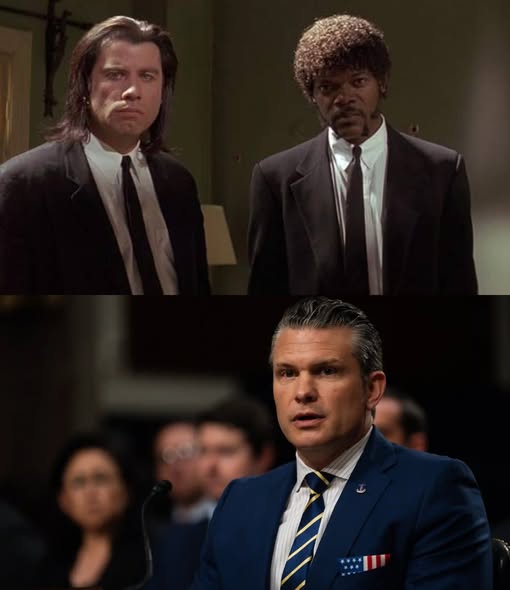
In a shocking display of theological misappropriation during a recent Pentagon worship service, Secretary of Defense Pete Hegseth appeared to invoke a fictional quote from Quentin Tarantino’s film Pulp Fiction as if it were a biblical scripture. The incident has ignited outrage across religious communities and political critics, highlighting concerns about the manipulation of faith in the context of military decisions.
According to witnesses, Hegseth, who also serves as the Secretary of War, took to the podium to deliver a prayer meant to invoke divine support for America’s ongoing tensions with Iran. He introduced the prayer as “CSAR 2517,” an allusion to Combat Search And Rescue missions, claiming it was based on Ezekiel 25:17. However, it was soon revealed that the verse was an outright fabrication.
In reality, the lines Hegseth read originated from Pulp Fiction (1994), where Samuel L. Jackson’s character, Jules Winnfield, recites an infamous speech before executing a character. Written by Tarantino, those words have no basis in the Bible and have become a cultural meme rather than sacred text. The actual Ezekiel 25:17 contains only a single sentence, vastly different from the fiery, vengeance-filled speech Hegseth paraphrased:
“The path of the righteous man is beset on all sides by the inequities of the selfish and the tyranny of evil men…” – Tarantino’s Pulp Fiction
Instead of biblical scripture, Hegseth effectively recited fictional dialogue to bless a war that has already resulted in over a thousand deaths and poses a grave threat to millions of Iranians. The shocking part? He termed this speech as “CSAR 2517,” suggesting it was rooted in military doctrine, but the entire prayer was lifted from a Hollywood script not meant to be taken as sacred text.
Following the incident, reactions poured in from religious figures worldwide. Pope Leo XVI publicly condemned the act, quoting Isaiah 1:15: “Even though you make many prayers, I will not listen. Your hands are full of blood.” Archbishop Reinhard Marx of Munich called Hegseth’s use of Tarantino’s lines “shameless blasphemy,” condemning it as a reckless distortion of faith to serve military aims.
The controversy underscores mounting concerns about the politicization of religion within the U.S. military and government. Critics argue that invoking fictional dialogue—particularly from a violent film—equates sacred scripture with pop culture, undermining genuine faith and dehumanizing the targeted populations, in this case, Iran.
Hegseth’s history as a provocateur is well-documented. The former Fox News host, known for praying for “overwhelming violence,” has previously fired army leadership over paranoia and invoked religious rhetoric to justify aggressive military actions. Now, he has demonstrated a troubling willingness to blend Hollywood entertainment with national security policies.
This disturbing incident raises serious questions about the integrity of religious practices in high-level government settings and the dangerous consequences of politicized faith, especially in matters of war and peace. The use of a fictional, violent movie line as a divine blessing for war underscores a troubling trend of using religion as a tool for aggression, rather than reconciliation.