
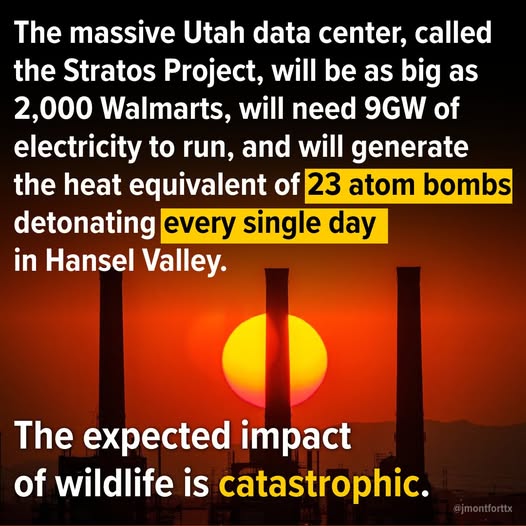
The tech industry’s future is taking a giant leap — or perhaps a giant gulp of energy — with the announcement of Utah’s colossal new data center, dubbed the Stratos Project. Located in the heart of Utah’s expansive desert landscape, this infrastructure marvel promises to redefine the limits of data storage and processing, but not without significant environmental considerations.
According to social media buzz and leaked project details, the Stratos Project will span an astonishing area equivalent to 2,000 Walmarts. Its vast footprint underscores the increasing demand for cloud computing, artificial intelligence, and digital services that continue to explode worldwide. The project’s scale is so enormous that it has become a viral sensation, with many users drawing comparisons to familiar landmarks to grasp its magnitude.
What truly captures attention is the staggering 9 gigawatts (GW) of electricity the facility will require—an amount roughly equivalent to the entire power consumption of a small country. To put this into perspective, the total energy demand of Utah itself hovers around 10 GW annually, meaning the Stratos Project alone will draw nearly as much power as the state produces in a year.
The immense energy needs don’t stop there. The data center will generate an extraordinary amount of heat during operation, comparable to the heat output of several small cities melting away in a controlled environment. This heat will necessitate innovative cooling solutions, likely involving large-scale refrigeration systems and cooling ponds, further complicating its environmental footprint.
Experts warn that such a massive energy draw could have profound impacts on local infrastructure, grid stability, and carbon emissions, especially if the electricity isn’t sourced from renewable energy. Advocacy groups are already raising concerns over the environmental sustainability of projects of this scale, urging tech giants and government agencies to prioritize green power sources.
The developers behind the Stratos Project claim that the facility will incorporate cutting-edge energy efficiency technologies and aim for a significant portion of its power to come from renewable sources like solar and wind. However, critics remain skeptical, emphasizing that the footprint, energy demands, and heat output pose serious challenges that could outweigh the benefits of increased digital infrastructure.
The unveiling of this project signals a pivotal moment in the evolution of data centers and underscores the urgent need for sustainable solutions to meet our growing digital needs. As the world watches Utah’s ambitious venture, questions about balancing technological advancement with environmental responsibility become more critical than ever.
Where to Learn More
- Inside the Massive Utah Data Center: The Stratos Project’s Design and Impact – TechToday
- The Environmental Impact of Data Centers and the Future of Sustainable Computing – Environmental News Network
- Utah’s Data Center Plans to Use Renewable Energy: Can It Deliver? – Recharge News
- Could Utah’s Massive Data Center Be a Climate Risk? – CNN Technology