
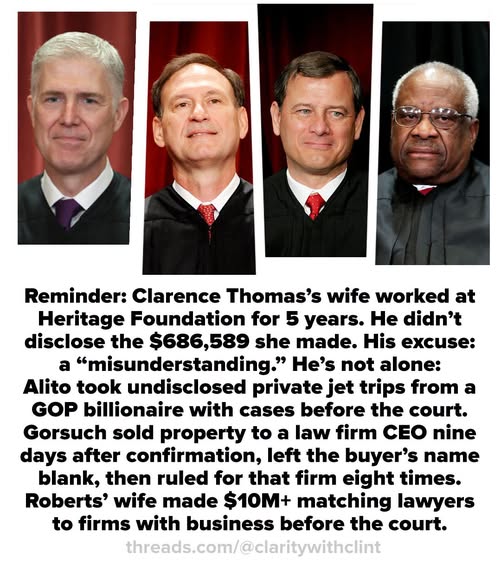
The controversy surrounding Supreme Court Justice Clarence Thomas has taken a new turn, shining a spotlight on financial transparency and potential conflicts of interest within the highest court in the United States. Social media users are buzzing over revelations that Thomas’s wife, Ginni Thomas, worked at the Heritage Foundation for five years, during which she reportedly earned $686,589—a figure she did not disclose in her publicly declared financial filings.
The issue first gained traction when a viral image surfaced online, reminding the public that “Clarence Thomas didn’t disclose his wife’s income,” challenging the transparency standards expected of federal judges and Supreme Court justices. Critics argue that failure to disclose such significant earnings raises questions about potential conflicts of interest and the influence of outside organizations on judicial impartiality.
Ginni Thomas has been a prominent and controversial conservative activist, often aligning with right-wing causes. Her work at the Heritage Foundation, a conservative think tank, has come under renewed scrutiny amid broader concerns about the ethical responsibilities of Supreme Court justices and their families. The $686,589 she earned over five years, according to the social media post, was reportedly omitted from Thomas’s financial disclosures, which are supposed to detail all sources of income and potential conflicts.
In response, Justice Thomas has dismissed the omission as a “misunderstanding,” but critics are not convinced. Senators and judicial watchdog groups have pointed out that such disclosures are critical for maintaining public trust in the judiciary. Transparency is especially vital for the Supreme Court, where justices are tasked with making impartial decisions that affect millions of Americans.
This isn’t an isolated incident. Critics highlight other cases where Supreme Court justices or their families have failed to fully disclose assets or income, raising ongoing debates about whether current disclosure rules are sufficient or need tightening. Some legal experts argue that the appearance of conflicts of interest, even if unintentional, can damage the court’s credibility and reinforce public perceptions of bias.
As the controversy continues to unfold, questions are mounting about the systemic transparency issues within the judiciary. The American public deserves open disclosure from public officials, especially those wielding the power to influence national policy through judicial decisions.
Legal analysts and advocacy groups are calling for clearer, more stringent disclosure requirements to prevent similar situations in the future. Meanwhile, the debate around the ethical boundaries and responsibilities of Supreme Court justices remains a hot-button issue amid calls for reform and increased accountability.