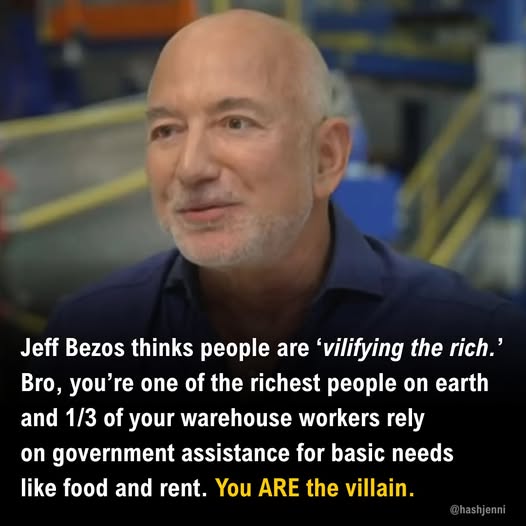
In a recent social media stir, billionaire Amazon founder Jeff Bezos drew widespread criticism after he shared a post claiming that the wealthy are being unfairly vilified. The post, which features an image with the statement “Jeff Bezos thinks people are ‘vilifying the rich,'” has ignited a buzz on platforms like Twitter and Instagram, especially among those pointing out stark contradictions in Bezos’s own business practices.
Bezos’s assertion comes at a time when public scrutiny of economic inequality is at an all-time high. Critics argue that his comments overlook the realities faced by many of his company’s employees, highlighting a troubling disconnect between the self-perception of America’s wealthiest and the experiences of everyday workers. Extensive reports have uncovered that approximately one-third of Amazon warehouse workers rely on government assistance programs such as food stamps and Medicaid to make ends meet, a statistic that has fueled accusations of corporate neglect and exploitation.
Indeed, Amazon, under Bezos’s leadership, has become a symbol of both remarkable innovation and controversial labor practices. A 2023 investigation revealed that many warehouse workers endure grueling schedules, physically demanding work environments, and high turnover rates. The reliance on government support among these workers raises questions about the true cost of Amazon’s soaring profits and Bezos’s characterization of the so-called “vilification” of the rich.
Many social media users have responded critically to Bezos’s claims, pointing out the apparent disparity between his statement and the lived experiences of his workers. “If Bezos really believes in the free market and the success of hardworking Americans, why are so many of his workers dependent on social safety nets?” tweeted one user. Others have expressed frustration over the persistent narrative that the wealthy are being unfairly targeted, suggesting instead that such criticism is rooted in accountability and the need for fair labor practices.
Bezos’s comments not only revive debates on economic inequality but also raise questions about the messaging from America’s ultra-wealthy. Critics emphasize that genuine conversation about the “vilification” of the rich must also include acknowledgment of the systemic issues that enable wealth disparities—issues that, many argue, Bezos and his corporate empire have played a significant role in shaping.
While Bezos has yet to respond directly to the backlash, the controversy underscores a broader societal reckoning: amid growing inequality, public discourse demands honesty and compassion towards workers, rather than dismissive narratives that dismiss their concerns. As debates around corporate responsibility, wealth, and social support continue, this social media incident serves as a reminder of the complex realities behind America’s richest figures and the ongoing struggle for economic justice.
Where to Learn More
- Amazon Warehouse Workers Rely on Government Assistance in Record Numbers – The New York Times
- Jeff Bezos Faces Backlash Over Comment on Vilification of the Rich – The Washington Post
- Inside Amazon’s Labor Practices and Worker Struggles – Reuters
- The Growing Gap in Wealth and Worker Welfare – BBC News