
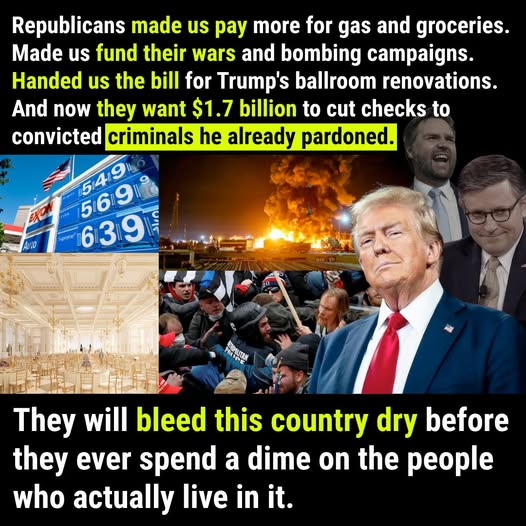
The recent surge of social media posts blaming political parties for economic hardships has ignited a fiery debate across online platforms. A viral image asserts that Republicans are responsible for increasing the cost of gas and groceries, funding wars and military campaigns, and even footing the bill for extravagant personal projects like former President Trump’s ballroom renovations. The message suggests a growing disconnect between public perception and the complex realities of governance, prompting many to question: who really bears the blame?
The post reads, in part, “Republicans made us pay more for gas and groceries. Made us fund their wars and bombing campaigns. Handed us the bill for Trump’s ballroom renovations. And now they…“—leaving the statement incomplete, but intentionally provocative enough to stir outrage and discussion.
Economists and political analysts have long debated the roots of rising living costs, especially in times of global uncertainty or national policy shifts. The truth is, inflation and economic fluctuations are influenced by a complex web of factors, including international energy markets, supply chain disruptions, federal monetary policy, and legislative decisions among both parties. While some attribute rising prices directly to government spending or policy decisions, economists warn against oversimplifying such a multifaceted issue.
Furthermore, the allegation that a single party, such as Republicans, is solely responsible for the country’s economic woes is an oversimplification. Legislative responsibilities are often bipartisan, and economic challenges are compounded by global factors beyond domestic control. However, these social media narratives tend to focus on contentious figures and controversial projects, like Trump’s luxurious ballrooms, which are used as symbols to criticize perceived extravagance or misallocation of funds.
Public perception, fueled by viral messages, can often distort the complex machinery of politics and economics for the sake of rallying support or opposition. It’s important for voters to critically evaluate these claims, consult reputable sources, and seek out nuanced analyses. As the adage goes, “Don’t believe everything you see on social media.”
In the end, politicized messaging like this serves as a reminder of the deep partisan divides in America today. While it’s easy to assign blame to one party or another, sustainable solutions require thoughtful, bipartisan efforts grounded in factual understanding—something that social media posts often lack.
Where to Learn More
- Understanding Economic Inflation: Causes and Solutions – Brookings Institution
- FactCheck: Does Government Spending Cause Inflation? – FactCheck.org
- What Impact Do Political Policies Have on the Economy? – NPR
- Global Markets and U.S. Inflation: What’s the Connection? – CNBC