
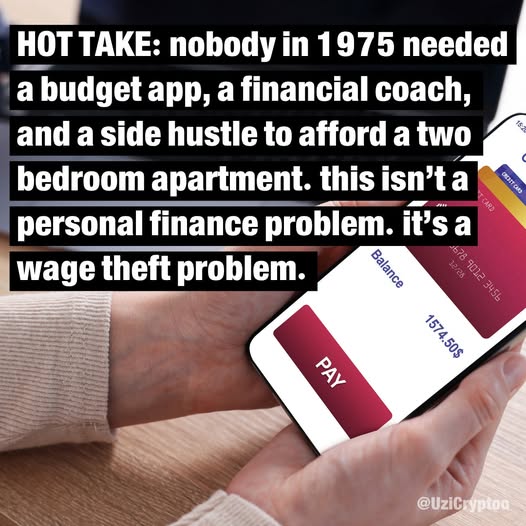
In recent social media buzz, a provocative statement has gone viral: “Nobody in 1975 needed a budget app, a financial coach, and a side hustle to afford a two-bedroom apartment.” This bold claim challenges our perceptions of today’s financial landscape, prompting a deeper look into whether modern money-management tools and strategies are truly revolutionary—or if they’re just new tricks on an old problem.
The viral post, accompanied by an image of a phone, cash, and the words “162 HOT TAKE,” suggests that people in the 1970s managed to afford housing without the aid of today’s digital financial aids or supplementary income sources. But is that entirely accurate? The short answer is complex, rooted in economic, social, and cultural shifts that have reshaped how we think about earning, saving, and spending money.
During the 1970s, the United States experienced a very different economic climate. Unemployment was high during the mid-decade, inflation was on the rise, and home prices, while lower relative to today’s standards, still presented barriers for many. Median home prices in 1975 hovered around $40,000, which, when adjusted for inflation, is roughly equivalent to over $200,000 today—difficult for many families without significant savings or income.
Moreover, household incomes in the 1970s were generally lower, and credit was less accessible. The rise of credit cards and digital banking in subsequent decades made borrowing and financial management more seamless, but that also introduced new challenges of debt, financial literacy, and overspending. It’s worth noting that many families relied heavily on familial support, community networks, or lived in shared households—factors that aren’t captured by the notion that no help was needed.
Today, the widespread availability of budget apps, financial coaches, and side hustles reflects a different economic reality—one where many individuals face higher living costs, stagnant wages, and an increasingly complex financial environment. These tools and strategies serve as essential aids to help navigate these modern challenges, especially for younger generations grappling with student loans, rent prices, and a gig economy that often lacks stability.
While it’s tempting to romanticize the past as a simpler or more financially stable time, it’s important to recognize that each era has its unique hurdles. The idea that early generations “just worked hard and got by” overlooks the systemic economic issues and social inequalities that shaped their realities. Similarly, dismissing today’s financial innovations as unnecessary fails to appreciate how they empower many to achieve goals that once seemed out of reach.
In the end, the viral debate highlights a broader conversation about economic fairness, technological progress, and financial literacy. It’s a reminder that financial struggles are not just a natural part of modern life, but also a reflection of structural changes over decades. Whether you’re using a budgeting app or working multiple jobs, understanding the roots of these challenges can foster more empathetic and effective solutions for all.
Where to Learn More
- Understanding the Economic Conditions of the 1970s – Investopedia
- The Role of Financial Literacy Today – Consumer Financial Protection Bureau
- Housing Costs and Affordability Over Time – Brookings Institution
- The Rise (and Challenges) of the Gig Economy – NPR
- A Look Back at the 1970s – History.com