
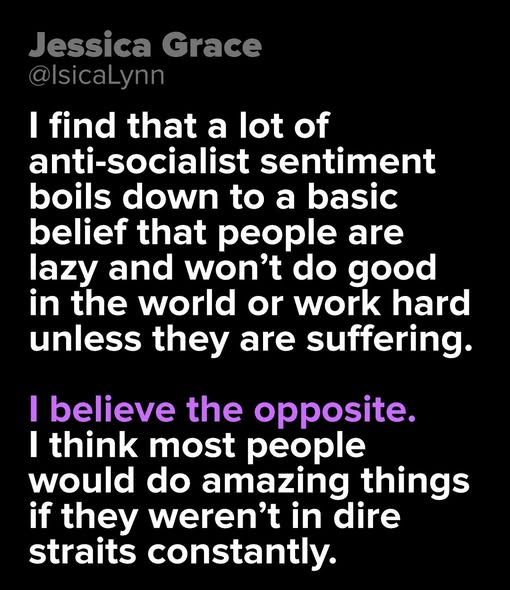
In a viral social media post that has sparked widespread discussion, user Jessica Grace (@IsicaLynn) made a thought-provoking observation: “I find that a lot of anti-socialist sentiment boils down to a basic belief that people are lazy and won’t do good in the world or work hard.” This statement challenges common stereotypes and invites a deeper look into the underlying reasons behind people’s political beliefs and attitudes toward socialism.
For years, socialism has been a contentious topic in political discourse, often polarized between staunch supporters and vehement critics. Critics frequently argue that socialism undermines individual motivation, claiming it discourages hard work by promoting wealth redistribution. Conversely, advocates argue that socialism can promote fairness, reduce inequality, and provide essential services to all citizens. But what about the stereotypes fueling opposition?
Jessica Grace’s insight suggests that a significant portion of anti-socialist sentiment may be rooted in a misconception: the belief that opponents simply see others as inherently lazy and unmotivated. This simplification overlooks the nuanced reasons many have reservations about socialism, including concerns about economic efficiency, government overreach, or philosophical differences about individual responsibility.
However, the stereotype of laziness is a reflexive and often unfair label that can foster misunderstanding. It assumes that individuals oppose socialism because they regard the less fortunate as inherently lacking effort—not acknowledging the complex societal, structural, or economic factors at play.
Psychologists and sociologists have long studied the roots of political beliefs, finding that attitudes toward economic systems like socialism are influenced by personal values, life experiences, and perceptions of fairness. Many critics of socialism are motivated by a desire to preserve incentives for innovation and individual achievement, not a hatred of the less fortunate.
The conversation around this stereotype is especially timely as debates over economic policies intensify amid global inequalities, climate crises, and post-pandemic recovery efforts. Public discourse often triggers emotionally charged narratives, which can entrench misconceptions like the “lazy citizen” stereotype.
Understanding that opposition to socialism doesn’t necessarily equate to laziness or apathy is vital for constructive debate. It encourages policymakers, activists, and citizens to address real concerns rather than caricatures. For example, many critics worry about the potential for government inefficiency—an issue that can be addressed through transparent reforms rather than dismissive labels.
Jessica Grace’s social media reflection reminds us to scrutinize the narratives we accept and challenge oversimplified stereotypes. Moving toward informed discussions requires acknowledging that political beliefs are multifaceted and rooted in diverse experiences—not just lazy assumptions about human nature.