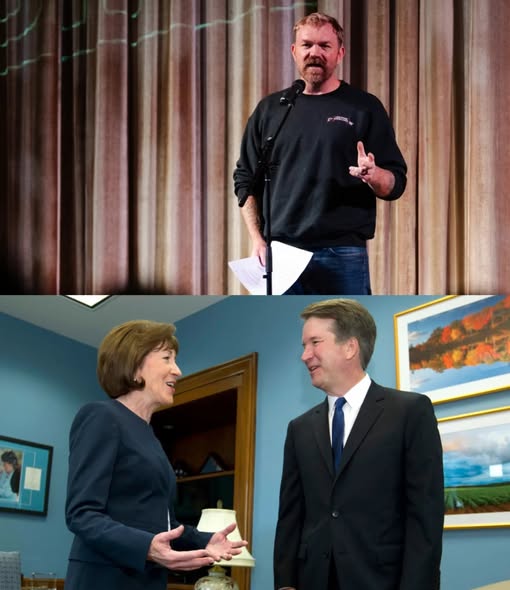
In a dramatic turn of political fate, Maine Senator Susan Collins is facing mounting criticism after her unwavering stance on Supreme Court Justice Brett Kavanaugh’s confirmation and her recent refusal to express regret for her pivotal vote. What once seemed like a strategic move has now become a defining moment, with her own words fueling opposition and exposing the choices that helped shape the current landscape of reproductive rights in America.
Back in October 2018, Collins played a crucial role in confirming Kavanaugh to the Supreme Court, walking onto the Senate floor with a lengthy 43-minute speech, then casting the decisive 49th votes that pushed his confirmation through. Despite meeting with him twice beforehand and publicly stating that he assured her Roe v. Wade was “settled law” and that he respected precedent, Collins now faces scrutiny for that decisive moment. Her vote is widely seen as integral to the court’s shift and the eventual overturning of Roe v. Wade in June 2022.
Fast forward to this week, when a reporter from News Center Maine posed a straightforward question: does she regret her vote now that Roe has been dismantled and reproductive rights are under threat? Collins’s response was telling. Instead of a simple yes or no, she declared, “I do not regret that vote,” then pivoted to dismiss the significance of the court’s decision in Maine, asserting that Dobbs had not truly changed anything locally — an assertion that blatantly ignores the reality faced by women across the state, many of whom now have limited access to abortion clinics.
Enter Graham Platner, an oyster farmer and combat veteran running against Collins, who has built his campaign around a clear message: “This is the court Susan Collins built, one confirmation vote at a time.” When Collins dismissed regret, Platner swiftly responded by sharing the clip on social media with a pointed comment: “You should.” His words resonated with many in Maine, where recent polls indicate a surprising shift. Women in particular are breaking for him by double digits, and Collins’s favorability ratings are slipping — a concerning trend for the senator who has represented Maine since the Clinton years.
Many argue this is the result of Collins’s own decisions. Her careful deliberation and meetings with Kavanaugh now seem like hollow defenses in the face of the tangible impact their votes have had on women’s rights. Critics remind the public that her vote helped install a justice who ultimately helped reverse nearly 50 years of constitutional protections for reproductive freedom. The question remains: why does Collins cling to her vote, refusing to show remorse while millions of women experience the consequences?
For Collins, the answer appears rooted in her desire to be seen as a careful, measured senator — but some in Maine and beyond see her actions differently. The voters are waking up to what many see as a betrayal, and her refusal to admit regret may be what costs her most in the next election cycle.
As the political landscape shifts in Maine, one thing is clear: the decision to confirm Kavanaugh is no longer a distant footnote, but a defining moment in the state’s political future. Collins’s own words now serve as a rallying cry for her opponents — a stark reminder of how a single vote can alter a reputation and a legacy.
Where to Learn More
- Susan Collins refuses to express regret for Kavanaugh vote — CNN
- Maine Voters Turn Against Collins Over Supreme Court Role — The New York Times
- How Susan Collins’s Supreme Court Vote Is Reshaping Maine Politics — Washington Post
- The fallout from Kavanaugh’s confirmation and its impact on American politics — BBC