
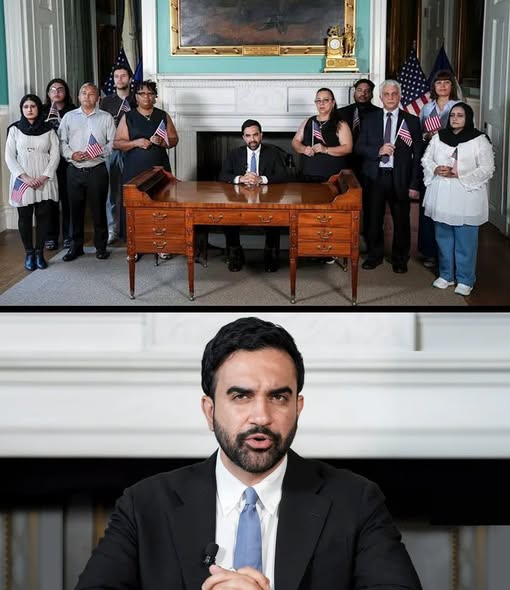
In a powerful and emotionally resonant speech delivered from the historic desk of George Washington at New York City Hall on Friday, Zohran Mamdani captured the hearts and minds of a diverse crowd just hours before former President Donald Trump’s incendiary remarks at Mount Rushmore. The speech, carefully timed to land at a moment of national reflection, offered a stirring reminder of what true patriotism entails—and it left a lasting impression on all who listened.
Standing amidst newly naturalized citizens holding tiny flags, Mamdani did not hold back in redefining patriotism. “Patriotism has never been about pretending our nation is without flaws,” he declared. “Patriotism is every act of righteous dissent. It is every march led under the heavy sun. It is every protest held a decade before its time. It is precisely because we love this nation that we will not leave it.” These words served as a timely counterpoint to the rhetoric often heard in national debates and political speeches, emphasizing that love of country can—and often should—be expressed through activism and critique.
Throughout the speech, Mamdani drew subtle yet powerful contrasts with the messages emerging from the nearby Mount Rushmore event. While the fireworks and patriotic displays of Mount Rushmore celebrate national pride, Mamdani’s tone was more nuanced, addressing the darker realities behind America’s ideals. Without ever mentioning Trump’s name, he pointed to the “masked agents terrorizing streets” and “spiriting away” undocumented neighbors in unmarked vans, referencing the ominous practices of immigration enforcement that continue to divide communities.
His critique extended to economic inequality, condemning the concentration of wealth in the hands of a few while millions labor with “calloused, dirt-streaked hands”—a stark reminder that America’s riches were forged through the hard work of ordinary people. He acknowledged the country’s lofty achievements, such as planting a flag on the moon and walking on the frontier of space, but reinforced that “the work of fulfilling the values first enshrined in the Declaration of Independence… that work endures, and it belongs to us all.”
What resonated most deeply from Mamdani’s speech was the tone of hope intertwined with critique. He spoke directly to the audience about their power to shape the meaning of America, inspiring listeners to see patriotism not as blind loyalty but as active participation in the ongoing project of justice and equality.
His concluding words, emphasizing that even if the frontier has closed and the moon has been conquered, the real frontiers—those of human rights, dignity, and justice—are still waiting for us to explore and define. “The frontier may be closed, we may have walked on the moon, but the work of fulfilling the values first enshrined in the Declaration of Independence, that work endures, and it belongs to us all.”
In an era often marked by divisiveness and polarizing rhetoric, Mamdani’s speech served as a compelling reminder that true patriotism involves hope, dissent, and action. It was a moment of affirmation—an appeal for Americans to reexamine what it means to truly love their country, not in spite of its flaws, but because of them.
Where to Learn More
- Zohran Mamdani’s Powerful Speech at NYC Hall Reflects on Patriotism and Dissent – The New York Times
- Mamdani’s Speech from Washington Desk Sparks National Dialogue — NBC News
- The Guardian: Reviewing Mamdani’s Call for Hope and Justice in America
- HuffPost: A Speech That Made You Feel Something About This Country Again