
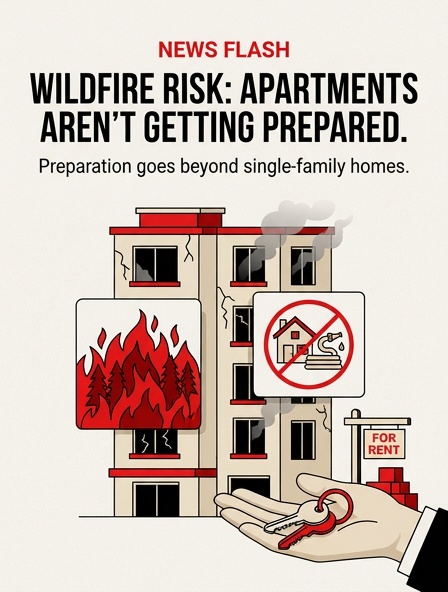
As wildfires sweep deeper into populated areas across the country, experts warn that traditional fire mitigation strategies centered solely on protecting single-family homes are no longer enough. With increasing frequency and intensity, wildfires are now threatening entire neighborhoods, forcing communities and officials to redefine how they approach wildfire preparedness.
Historically, much of the focus has been on individual homeowners creating defensible space — trimming trees, clearing brush, and installing fire-resistant materials. These measures undoubtedly help reduce the risk of ember intrusion and direct flame contact. However, recent fire seasons have shown that this approach alone falls short when entire communities face encroaching flames from large, fast-moving wildfires.
In many recent cases, wildfire flames leap from forested areas, burning through subdivisions and sweeping across multi-acre developments. These large-scale fires often produce embers carried by wind that can ignite structures miles away from the main fire front. This phenomenon, known as “ember storming,” can rapidly turn a neighborhood into a heap of ash despite well-maintained individual homes.
Experts emphasize that municipalities must shift towards a more comprehensive community-wide strategy involving regional planning, improved infrastructure, and coordinated evacuation plans. “Focusing solely on the homeowner level is outdated,” says Dr. Laura Martinez, a wildfire risk management specialist. “Communities need to establish defensible zones, create fuel break corridors, and develop rapid response systems that encompass entire neighborhoods.”
Some innovative solutions include constructing fire-resistant community features such as shared firebreaks, installing communal sprinkler systems, and creating buffer zones with non-flammable landscaping. Moreover, urban planning that avoids overconcentration of combustible vegetation or structures can significantly reduce devastation.
In addition to physical infrastructure, public awareness and education play crucial roles. Local governments are now encouraging residents to participate in community defensible space programs and to understand the importance of fire-smart landscaping beyond individual properties.
The rising threat of wildfires reaching beyond rural forests into densely populated areas demands a fundamental reevaluation of current policies. As climate change continues to exacerbate wildfire conditions, resilient communities depend on integrated, multi-layered defenses that go beyond the perimeter of single-family homes.
Ultimately, a collective effort involving government agencies, communities, and individual residents will be vital to mitigate future wildfire impacts and protect lives and property more effectively in an era of unprecedented fire danger.
Where to Learn More
- Community Wildfire Protection Plans – U.S. Forest Service
- Firewise USA Program – National Fire Protection Association
- Planning and Preparing for Wildfires – Ready.gov
- Wildfire Safety Tips – National Fire Protection Association
- Wildfire Risk Reduction Resources – USDA Natural Resources Conservation Service