
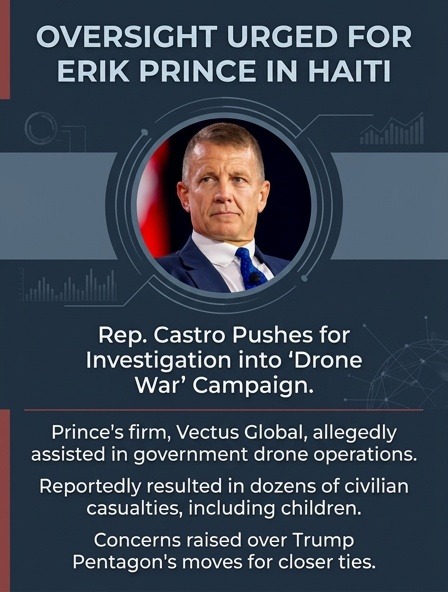
Controversy surrounds the covert drone campaign in Haiti as U.S. Representative Joaquin Castro demands increased oversight of private military contractor Erik Prince’s involvement in what critics are calling a “deadly drone war” against Haitian civilians.
According to recent social media disclosures and investigative reports, Prince’s firm Vectus Global has played a significant role in supporting the Haitian government’s controversial drone operations. These campaigns have reportedly led to the death of dozens of civilians, including children, fueling international outrage and raising urgent questions about accountability and transparency.
“We cannot allow secret drone strikes to become the norm, especially when innocent lives are at stake,” Castro stated in a recent tweet, calling for congressional oversight and independent investigation into these operations. He emphasized that the use of targeted drone strikes must adhere to international human rights standards, and that any civilian casualties must be thoroughly examined.
These revelations come at a time when the Biden administration is navigating complex relationships with private military firms, particularly Erik Prince’s Vectus Global. Under the current political climate, the Trump-era Pentagon has pushed for closer ties with private contractors, citing efficiency and strategic advantages. However, critics argue this approach sidesteps traditional military oversight and accountability, especially in volatile regions like Haiti.
Haiti, long plagued by political instability and socioeconomic challenges, has become a testing ground for unconventional U.S. military intervention strategies. Evidence suggests that the Haitian government, with the aid of private military contractors, has employed drone surveillance and targeted strikes against criminal groups, but not without tragic consequences. International observers warn that the lack of transparency could escalate human rights abuses and erode trust within the Haitian population.
Both human rights organizations and affected families are demanding a full investigation into these operations. The controversy centers not only on the legality of targeted killings but also on the questionable transparency of private firms’ activities in foreign countries. Rep. Castro’s call for oversight aims to illuminate these clandestine operations, forge clear legal boundaries, and prevent future civilian casualties.
Meanwhile, the Trump Pentagon’s push to deepen ties with private military firms like Vectus Global signals a broader shift toward privatization of military functions. Supporters argue that private companies can provide specialized services more efficiently, but critics warn that this approach increases the risk of unchecked military action and diminished accountability.
As the debate heats up, questions remain: How much oversight is enough? Who bears responsibility for civilian harm? And what role should private military contractors play in foreign conflicts moving forward? For now, lawmakers like Rep. Castro are vowing to push for transparency and accountability in what has become one of the most scrutinized covert operations in recent history.
Where to Learn More
- Exclusive: U.S. Private Contractors and the Secret Drone War in Haiti – The New York Times
- Human Rights Groups Call for Transparency Over Drone Campaign in Haiti – Human Rights Watch
- Reuters Investigation: Private Military Firms and the Haitian Drone Operations
- Congressional Hearing on Private Contractors and Military Operations