
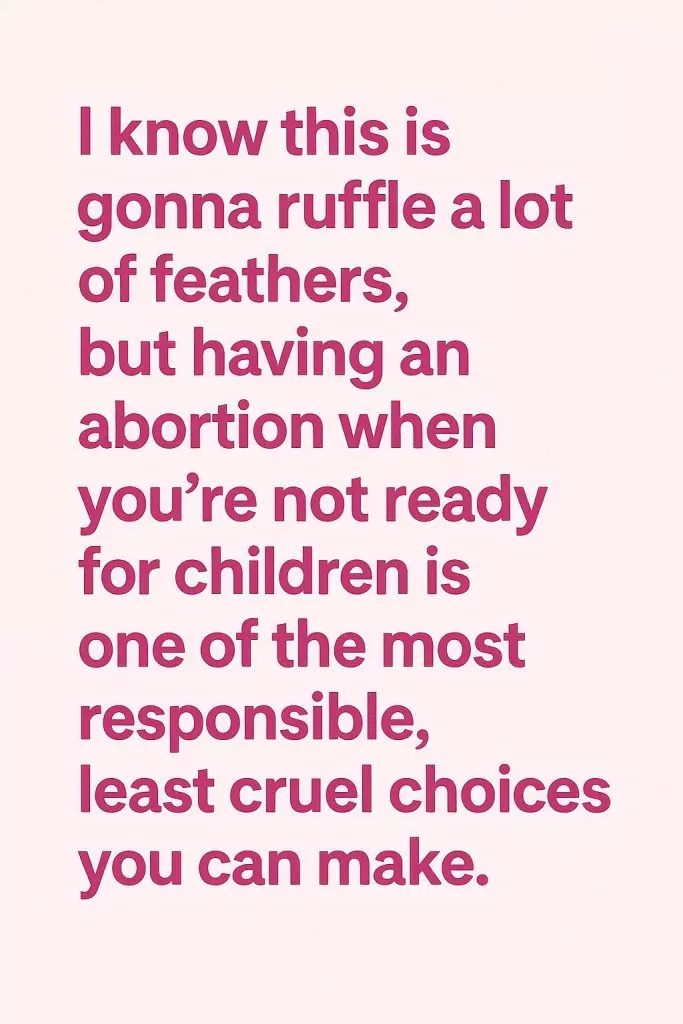
In a social media post that has rapidly gone viral, one statement has ignited fervent discussion about the ethics and responsibilities surrounding abortion. The post simply reads, “I know this is gonna ruffle a lot of feathers, but having an abortion when you’re not ready for children is one of the most responsible, least cruel choices you can make.”
This straightforward yet provocative message touches on a deeply polarizing topic, but its popularity underscores a growing discourse about autonomy, preparedness, and morality. Advocates and critics alike are weighing in on whether abortion should be framed as a responsible act rather than a controversial or regrettable one.
The argument for responsibility: Supporters argue that choosing abortion when one is unprepared for parenthood is an accountable decision that considers the welfare of all involved — the parent, the child, and society. They say it prevents hardships that might arise from bringing a child into unfavorable conditions, such as financial instability, emotional unreadiness, or lack of support systems.
“Recognizing abortion as a responsible choice acknowledges that not all pregnancies lead to ideal circumstances,” said Dr. Emily Harper, a reproductive health specialist. “It respects individuals’ ability to make decisions about their lives and futures without stigma.”
Many proponents also highlight the compassion embedded in this viewpoint, suggesting it is “least cruel” because it avoids forcing a child into neglect or hardship.
The counterarguments: Detractors contend that labeling abortion as responsible oversimplifies the complex moral and emotional dimensions involved. Some argue that it risks normalizing a choice that should be an absolute last resort.
Religious groups, anti-abortion advocates, and some ethicists emphasize the value of every potential life, viewing abortion as inherently harmful regardless of circumstances. They warn that reducing abortion to responsibility rhetoric may disregard alternative support systems, such as adoption or community aid for parents facing hardship.
Social media’s role in amplifying debate: The viral post has become a flashpoint demonstrating how digital platforms foster quick dissemination of radical ideas and amplify emotional responses. It reflects wider generational and cultural shifts toward recognizing reproductive rights as fundamental human rights.
Many young people on platforms like Twitter, TikTok, and Instagram are reshaping conversations by blending personal testimony with advocacy, pushing for destigmatization and policy change. Meanwhile, opponents leverage these same platforms to rally counter-movements centered on protection of fetal life.
Political and legal context: In many countries, abortion remains a divisive legal issue with varying degrees of access. Recent legislative changes in the United States, for example, following the Supreme Court’s reversal of Roe v. Wade, have intensified public scrutiny of abortion discourse and heightened the stakes of these conversations.
Overall, the viral post captures a cultural moment where the boundaries of morality, personal freedom, and societal expectations are being actively redefined. Whether viewed as ruffling feathers or opening necessary dialogues, it invites everyone to reconsider what responsible choices really mean amid complex human realities.
Where to Learn More
- Understanding Abortion – Planned Parenthood
- Abortion Factsheet – World Health Organization
- The State of Abortion Policy in the U.S. – Guttmacher Institute
- Supreme Court Overturns Roe v. Wade – The New York Times
- The Ethics of the Abortion Debate – Brookings Institution