
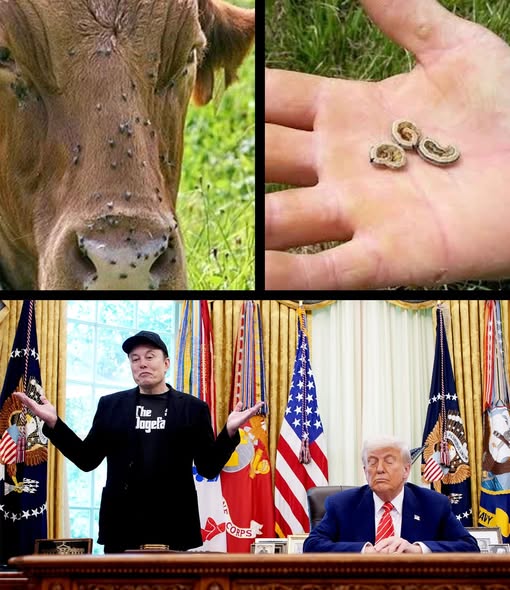
The terrifying return of the New World screwworm has been officially confirmed in Texas, reigniting fears of a deadly parasitic invasion that was once considered eradicated in North America. A three-week-old calf in Zavala County tested positive this week, marking a disturbing milestone for livestock health and food security across the region.
But this outbreak isn’t occurring in a vacuum—experts warned that the spread of the screwworm, a flesh-eating fly whose larvae tunnel into living tissue, was only a matter of time. Originating in Central America and Mexico, the pest has been steadily migrating northward since at least 2022, with projections indicating it would reach U.S. borders by 2025. Now, those predictions are coming true, with Texas on the front lines.
The root cause? A perfect storm of regulatory neglect and budget cuts. The federal program responsible for controlling screwworms—notably through the release of sterilized male flies to prevent reproduction—has been critically weakened. As a consequence of the Trump administration’s decision to slash approximately 15 percent of the USDA workforce—around 15,000 employees tasked with monitoring and combatting agricultural pests—the agency’s capacity to respond in a timely and effective manner was severely compromised.
The program, which relies on international cooperation and precise scientific protocols, is slow and painstaking by design. Its effectiveness depends on maintaining a steady release of sterile flies to keep wild populations in check. With resources stripped and personnel reduced, these measures are now behind schedule, leaving American livestock vulnerable.
The political irony is glaring: the cuts were primarily driven by tax benefits for the wealthy, with little regard for the long-term consequences on food safety or economic stability. Now, cattle farmers—many of whom supported hefty tax cuts for the wealthy—are footing the bill.
Already, the impact has affected prices at the grocery store. Beef prices hit record highs in December 2025, with ground beef climbing to $6.69 per pound—a staggering 72% increase since 2020. Additionally, the border closures and disruptions have eliminated over a million Mexican feeder cattle from the U.S. supply chain, tightening supply and driving wholesale beef prices to forecast another 6.9% increase in 2026, according to USDA projections.
This situation underscores a dangerous consequence of underfunding and neglect of agencies meant to protect American agriculture. As Texas State Republican Rep. David Miller pointed out over a year ago, “federal regulators moved at a snail’s pace,” a hesitation that’s now costing ranchers and consumers dearly.
The ranchers who once cheered for policies favoring tax cuts for the rich are now confronting the very pests and price hikes they overlooked. The arrival of flesh-eating maggots in herds is a stark warning: neglecting basic scientific safeguards and oversight can have devastating, tangible impacts on everyday Americans, from farmers to families at the grocery store.
Where to Learn More
- USDA Announces New Plan to Combat Emerging Screwworm Threat – USDA
- What Is the Screwworm and Can It Be Stopped? – National Geographic
- Texas Faces New Livestock Threat as Screwworm Confirmed – Texas Tribune
- International Cooperation Essential for Controlling Screwworm – USDA National Institute of Food and Agriculture