
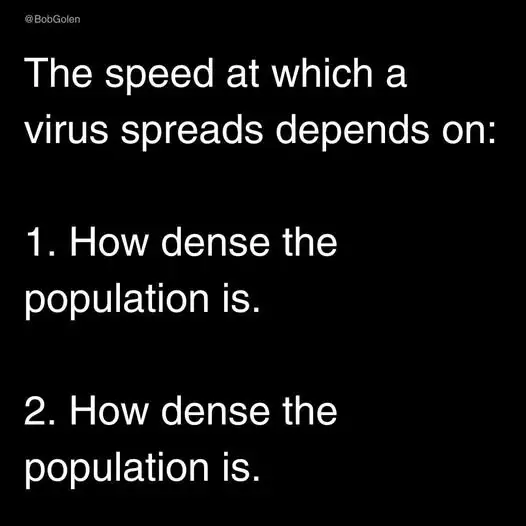
In the world of infectious diseases, understanding how viruses spread is crucial for managing outbreaks and implementing effective public health measures. Recently, a viral social media post humorously highlighted a common misconception about virus transmission, saying, “@BobGolen The speed at which a virus spreads depends on: 1. How dense the population is. 2. How dense the population is.” While it may sound like a joke, it underscores an essential truth: population density plays a significant role in determining how quickly a virus can propagate through a community.
Many people assume that the total number of people in an area is the main factor influencing viral transmission. However, epidemiologists emphasize that *population density*—the number of people living per unit area—is often more critical than sheer population size.
Why does density matter? In densely populated areas, individuals are more likely to come into close contact with others, increasing the chance of virus transmission. For example, crowded urban centers with narrow streets, packed public transportation, and busy marketplaces provide ideal conditions for airborne or contact-based viruses to spread rapidly.
On the other hand, regions with the same population but more spread-out communities tend to see slower spread rates. Think about rural areas where homes are spaced far apart; even with a large overall population, limited daily interactions can reduce transmission opportunities.
This principle was evident during the COVID-19 pandemic. Cities like New York City experienced explosive outbreaks early on, largely due to high residential density. Conversely, less dense communities often saw infections spread more gradually.
But it’s not just about the physical scenario. Human behavior, public health policies, and infrastructure also influence how quickly a virus moves through a population. Mask mandates, social distancing protocols, and vaccination rates can significantly alter the trajectory of an outbreak, regardless of density.
The viral social media post’s blunt repetition — “How dense the population is” — humorously emphasizes the importance of considering density as a primary factor. It’s a reminder for policymakers and health officials to focus on high-density areas when deploying containment measures, testing, and vaccinations.
As urbanization continues to increase worldwide, understanding how density influences disease spread becomes even more crucial. It can help in designing smarter, more targeted responses to future pandemics, ultimately saving lives.