
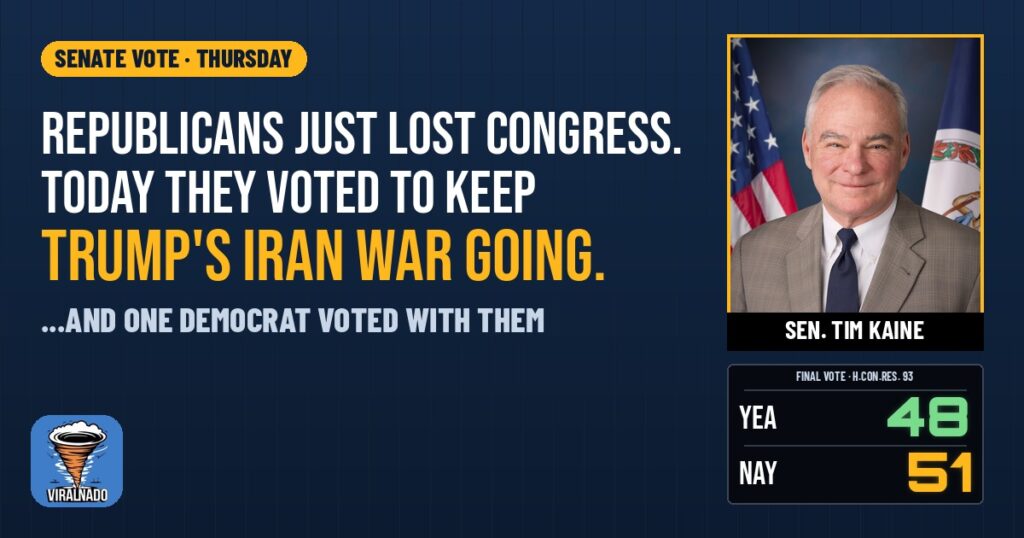

Just over two weeks after voters stripped Republicans of control of both chambers of Congress, Senate Republicans on Thursday voted down an effort to end President Donald Trump’s war with Iran.
The war powers resolution, H.Con.Res. 93, failed 48-51. It was the first vote on the war in either chamber since the Nov. 3 midterm elections, in which the GOP lost both the House and the Senate beginning next year, The Guardian reported. The Associated Press called it the Senate’s first word on the conflict since the party’s “sweeping losses.”
Who crossed the aisle
Three Republicans, Sens. Susan Collins of Maine, Lisa Murkowski of Alaska and Rand Paul of Kentucky, joined Democrats in voting to end the war. All three have backed previous resolutions.
But one Democrat went the other way. Sen. John Fetterman of Pennsylvania, an ardent supporter of Israel, was the only Democrat to vote against the measure, according to The Hill. Sen. Chris Murphy of Connecticut, who is recovering from a stroke he suffered last month, missed the vote, The Washington Post reported.
Two Republicans who have broken with Trump on the war before also stayed with their party this time. Sen. Thom Tillis of North Carolina, who is retiring at the end of the year, voted for a war powers resolution in September but voted against this one. Sen. Bill Cassidy of Louisiana, also on his way out, voted no as well, even though his support was crucial when a resolution passed both chambers in June, according to The Guardian.
“I’ve supported some. I mean, you do know resolutions differ from each one. This one doesn’t go to the president, so it’s just a statement from Congress,” Tillis told reporters, according to The Hill. “I’ve made that statement. I don’t need to vote on a Democrat resolution to make that statement.”
Kaine: ‘I alone can break it’
Sen. Tim Kaine of Virginia, who has led the Senate push to end the war, urged his colleagues on the floor before the vote to “do what the Constitution demands, what our public demands, and that is to end this illegal war.”
“Dozens of U.S. troops have died, hundreds have been injured, hundreds if not thousands of Iranian civilians have been killed,” Kaine said. “And the American public is tired of it. The American public is also tired of escalating gasoline and diesel prices.”
Kaine argued the war was “unconstitutional from the start because it was not a war of imminent defense and the president did not seek a congressional authorization required by the Constitution,” and that it became illegal under the War Powers Act of 1973 once it continued past 60 days without approval from Congress.
He said the war’s unpopularity was made “manifestly clear in the election results from November 3,” calling the midterms a “historic repudiation” of the party holding the White House.
Then he turned Trump’s own words against him. “President Trump once said something famously: ‘I alone can fix it,'” Kaine said. “But he has proven the counter proposition: I alone can break it.” He pointed to two decisions he said Trump made on his own, sweeping tariffs and the war with Iran, which he said have “hurt the economy, hurt our troops, hurt their families.”
“But we here in the Senate, we have the capacity to fix it,” Kaine said.
The other side
Sen. Tim Sheehy, R-Mont., urged colleagues to vote no. “Iran is not a war of choice. It’s a war of necessity,” he said on the Senate floor, according to C-SPAN. “There is no deal with Iran, they don’t understand deals.”
Earlier in the debate, Sen. Peter Welch, D-Vt., read aloud the names of U.S. service members killed in the war. He said Trump had “broken a promise he made to the American people when he ran for president: to make certain that it was America first.”
A $48 billion war
The war began in February with a joint U.S.-Israeli attack on Iran. Democrats have forced vote after vote on it since then. One resolution passed both chambers in June, but Trump ignored it, The Guardian reported. The House approved Thursday’s measure, led by Rep. Seth Moulton, D-Mass., 220-204 in September, with seven Republicans joining every Democrat. Several of those Republicans went on to lose their re-election races.
Because it is a concurrent resolution, the measure would not have gone to Trump’s desk even if it had passed. Democrats wanted to put Republicans on the record, The Hill reported.
The price tag keeps climbing. At a Senate Armed Services Committee hearing on Thursday, a Pentagon budget official told Sen. Richard Blumenthal, D-Conn., that the war had cost $48.3 billion as of Nov. 13, up from just over $47 billion in October, according to The Hill. That figure does not include the full cost of damage to U.S. military facilities in the Middle East.
What happens next
The next fight is over money. Government funding runs out on Dec. 11, and Senate Majority Leader John Thune warned that Democrats “may try to initiate another, a third government shutdown this year,” Fox News reported.
Kaine pushed back, saying Republicans would be the ones to blame if they insisted on funding “a war that’s illegal, and the American public hates.” “That’ll be on them, not on us,” he said. “We’re not gonna shut government down.”
“We’re in a really tough place,” Sen. Chris Coons, D-Del., acknowledged. “I’ve been saying for months that the war with Iran has no support in my caucus. We are searching for responsible ways to bring it to an end.”
Democrats take control of both chambers in January. Until then, Thursday’s vote puts on the record which senators still back the war.