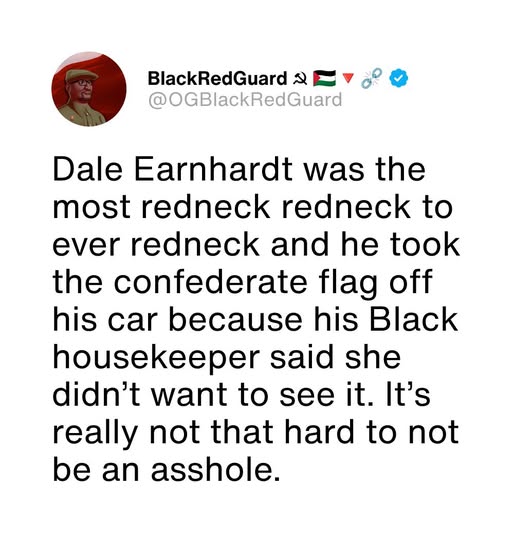
The social media world was recently set ablaze by a provocative and widely-shared post claiming that legendary NASCAR driver Dale Earnhardt was the “most redneck redneck” to ever embrace the stereotype—going so far as to remove a Confederate flag from his car because of his Black housekeeper. Although the claim has generated significant buzz, many are questioning its accuracy and context, highlighting the importance of fact-checking stories that go viral online.
The post, shared by the user @OGBlackRedGuard, features a bold statement suggesting that Earnhardt’s decision to remove a Confederate flag—often associated with contentious history—was influenced by his Black housekeeper. The message reads, “Dale Earnhardt was the most redneck redneck to ever redneck and he took the Confederate flag off his car because his Black housekeeper.”
Confederate flags have long been controversial symbols in the United States, provoking debates over heritage, racism, and historical remembrance. Dale Earnhardt, a figure celebrated for his contribution to racing and often regarded as a blue-collar hero, is often associated with wholesome, traditional Americana. However, there is limited evidence to suggest that Earnhardt himself prominently displayed or removed Confederate symbols, much less that his actions were directly motivated by his personal relationships or his housekeeper.
In fact, Earnhardt’s legacy is complex. While some fans and observers remember him as a symbol of Southern pride, others emphasize his focus on racing excellence and his more approachable persona. There are scarce credible reports indicating that Earnhardt publicly made statements about Confederate flags or that his personal decisions regarding symbols on his cars were influenced by racial considerations.
The viral post touches on sensitive topics—race relations, symbolism in sports, and personal choices—highlighting how social media often blurs the lines between fact and opinion, sometimes embellishing stories for shock value or viral impact.
Scholars and sports historians urge caution in taking social media claims at face value. It’s essential to verify details through reputable sources. In the case of Dale Earnhardt, there is no documented evidence that he had a Confederate flag on his car or that he made the decision to remove one due to his housekeeper’s influence. Instead, many responses emphasize the importance of understanding the context of symbols and respecting the complexity of individual personalities and histories.
This incident underscores how viral stories can shape perceptions—sometimes inaccurately—and the importance for consumers of social media content to seek out verified information. As conversations about race, history, and symbolism continue to unfold in the United States, it remains vital to approach such topics with nuance, critical thinking, and respect for facts.