
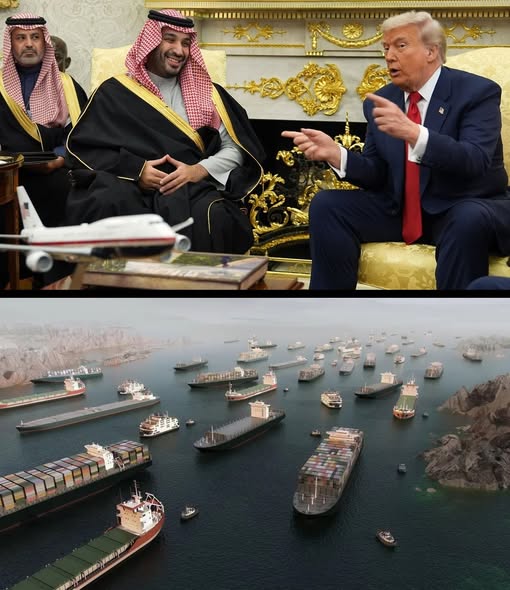
The once-close alliance between the United States and Saudi Arabia is showing signs of strain, this time fueled by a controversial new operation announced by former President Donald Trump. On his social media platform, Truth Social, Trump revealed “Project Freedom,” a naval mission designed to escort commercial ships through the strategically vital Strait of Hormuz—a waterway currently under Iranian blockade.
The announcement caught allies in the Gulf off guard, leading to an immediate diplomatic backlash. Saudi Arabia responded by suspending U.S. military access to its bases and airspace, marking a significant escalation in the simmering deterioration of relations. This move signals a departure from years of seemingly close cooperation, especially considering Saudi’s pivotal role in Middle Eastern geopolitics.
The situation was further complicated by a failed diplomatic call between Trump and Crown Prince Mohammed bin Salman. Reports indicate that the call was unproductive, leaving ongoing tensions unresolved. Meanwhile, neighboring Gulf nations—Qatar, Oman, and Kuwait—were similarly blindsided, with some revealing that the U.S. failed to coordinate with them beforehand. In particular, Qatar’s emir was not contacted until after the operation was already underway, and Oman was kept in the dark until the announcement was made public.
Adding to the complexity, the episode occurs amidst a delicate ceasefire in the region, with the U.S. and Iran actively exchanging fire in the Gulf. Despite these ongoing hostilities, officials in the Trump administration insisted that “everything is fine,” and that the naval operation was a necessary show of strength.
This dramatic turn of events is especially striking considering the historical closeness between Trump and Saudi Arabia. For years, the relationship appeared almost fraternal. Jared Kushner’s private equity firm notably secured a $2 billion investment from a Saudi sovereign wealth fund controlled by MBS, despite internal advisories against such a move. That same Saudi wealth fund has heavily financed LIV Golf, a tour that has partnered with Trump’s golf properties and profited from Persian Gulf investments.
Now, however, the Saudis have pulled the plug on their funding of LIV Golf, signaling a shift away from the sports diplomacy leverage Trump previously enjoyed. LIV’s ongoing tournaments, including one at Trump National in Virginia, continue despite these funding setbacks, highlighting the disconnect between political tensions and business interests.
This pattern echoes Trump’s earlier diplomatic approach, which often involved alienating traditional allies—be it Canada, NATO nations, or European powers—culminating in a global landscape increasingly wary of American leadership. The recent Gulf developments suggest that the same pattern is unfolding in the Middle East. The Gulf states—long hosts of U.S. bases and intelligence sharing—are quietly pushing back through actions like blocking airspace, withholding funds, and ignoring high-level calls.
While these moves may seem subtle compared to the fiery rhetoric of other conflicts, they underscore a broader shift in regional diplomacy—away from certainty toward uncertainty, and from close partnerships to cautious independence. As the Biden administration and Congress watch these developments unfold, the question remains: how long can the U.S.-Gulf alliance withstand these growing tensions fueled by unpredictable leadership moves?
Where to Learn More
- Trump’s Naval Escort Plan Sparks Gulf Diplomatic Crisis – Reuters
- Saudi Arabia Suspends US Military Access Amid Rising Tensions – Al Jazeera
- How Trump’s Middle East Moves Are Reshaping Alliances – The New York Times
- U.S.-Saudi Ties Fraying as Gulf Leads Pushback – The Wall Street Journal