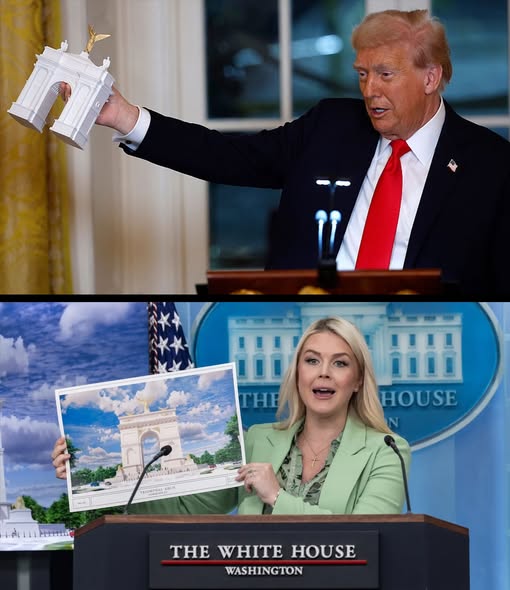
In a move raising eyebrows across the nation, former President Donald Trump is moving ahead with construction of a towering 250-foot Triumphal Arch in Washington, D.C., stretching between the Lincoln Memorial and Arlington National Cemetery. However, this ambitious project is facing immediate legal hurdles, with critics warning that it may violate federal laws and echo dark chapters of history.
Without securing congressional approval, Trump has relied on a controversial decision by a Commission of Fine Arts he personally appointed after replacing the previous members. The commission, which traditionally reviews monuments and public art, has declared the project approved—an assertion that legal advocates sharply contest. Public Citizen Litigation Group has already taken legal action, arguing that unless Congress enacts explicit legislation, the construction is outright unlawful.
The echoes of history are difficult to ignore. The proposed arch bears an uncanny resemblance to a project once envisioned by Nazi architect Albert Speer, who designed a colossal triumphal arch for Hitler’s “World Capital Germania.” Speer’s planned arch was so massive it could have housed the entire Arc de Triomphe inside its opening—a symbol of ego and imperial grandeur. While Speer’s arch was never constructed—rejected partly due to Berlin’s soil limitations—the parallels to Trump’s recent move are striking. Workers are now conducting geotechnical tests along the Potomac River to determine whether Washington’s soil can support this kind of enormous structure; a modern-day soil test echoing the historical uncertainty about Speer’s designs.
This isn’t an isolated incident. Under his administration, Trump oversaw the demolition of the White House East Wing and awarded a no-bid contract worth $300 million for an opulent ballroom to friends and associates—actions criticized as disregarding standard approval processes. Additionally, he painted the Lincoln Memorial Reflecting Pool a vivid “American Flag Blue” without undergoing the mandatory consultations mandated by the National Historic Preservation Act. In both cases, federal judges intervened to halt these projects, underscoring the ongoing legal and environmental debates surrounding his approach to historic preservation.
The pattern emerges clearly: amid claims of national greatness, Trump appears determined to leave his mark on Washington—often at the expense of established laws and historic integrity. Critics contend that these actions are distortions of federal processes, reflecting a reckless disregard for the years of effort that have shaped the nation’s capital. His supporters, meanwhile, argue that the projects represent a bold assertion of American pride, regardless of legal or historical concerns.
As geotechnical testing continues along the Potomac—an effort to assess whether the soil can bear the weight of the proposed arch—legal battles are intensifying. Several lawsuits challenge the project’s legality, emphasizing that monumental architecture driven by ego threatens the historic fabric of Washington, D.C. This conflict harks back to a pattern of disregarding established procedures in favor of personal projects that leave a lasting, if controversial, imprint on the nation’s capital.
Where to Learn More
- Public Citizen Litigation Group – Legal challenges against Trump’s construction projects
- New York Times – Court Halts Trump’s Trump’s Unapproved Projects – Coverage of legal actions on historic preservation and project approvals
- Washington Post – The History and Controversy of Monuments in D.C.
- National Archives – Laws Governing Federal Projects and Historic Preservation
- BBC – Echoes of History in Modern Monument Building