
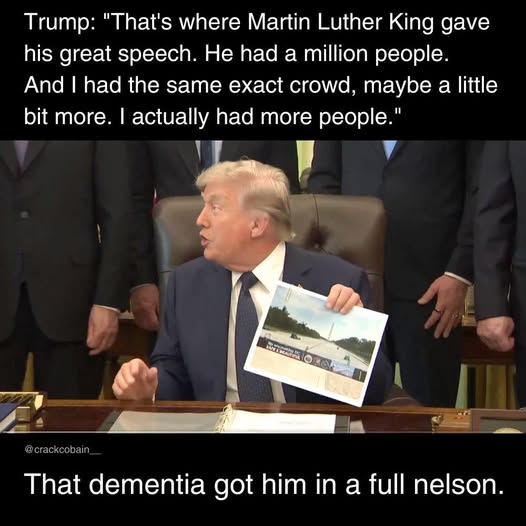
Former President Donald Trump stirred controversy and confusion earlier this week with a remark that has quickly gone viral across social media platforms. During a speech in the Oval Office, Trump made a bold claim about his own crowd size, asserting, “That’s where Martin Luther King gave his great speech. He had a million people. And I had the same exact crowd, maybe a little bit more.”
The statement has sparked widespread debate among political analysts, historians, and Americans watching from home. Critics argue that Trump’s comparison undermines the historical significance of Dr. Martin Luther King’s 1963 “I Have a Dream” speech, which took place during the March on Washington and drew an estimated crowd of a quarter of a million people, not a million. Many have taken to social media to question the veracity of Trump’s claim, with some pointing out that over the decades, crowd size estimates for King’s speech have ranged from 200,000 to 300,000, far less than a million.
Supporters and Trump allies, however, emphasize the former president’s attempt to frame his rally as a historic event, comparing it to one of the most iconic moments in American civil rights history. They argue that Trump’s statement was meant to highlight the large turnout at his events and to suggest a momentous crowd presence, which he claims rivals or exceeds that of King’s speech.
This isn’t the first time Trump has faced scrutiny for exaggerating crowd sizes; critics often point to his claims about attendance at rallies and his inauguration in 2017. Crowd size controversies have become a recurring theme throughout his political career, often igniting debates over facts versus perception.
Historically, the “March on Washington” where King delivered his speech is considered a pivotal moment in the Civil Rights Movement. It was held on August 28, 1963, with an estimated 250,000 participants advocating for racial equality and justice. The event remains one of the largest gatherings for civil rights in U.S. history, and its historical significance continues to resonate today.
The Oval Office remark also raises questions about the importance of historical memory and the ways political figures frame their accomplishments. Critics contend that such statements undermine the gravity of the civil rights movement, while supporters see it as a reflection of Trump’s confidence and bravado.
As social media users continue to dissect the claim, many are calling for more fact-based discussions around the civil rights movement and the importance of genuine historical understanding. Whether Trump’s crowd estimate was literal or rhetorical, the remark has undoubtedly sparked a fresh wave of debate on social media about leadership, history, and the power of words in shaping public perception.
Where to Learn More
- The March on Washington: History and Significance – History.com
- Fact-Checking Trump’s Crowd Claim: Experts Weigh In – NPR
- Civil Rights Movement and the March on Washington – National Civil Rights Museum
- Analysis of Trump’s Oval Office Remarks – The Washington Post