
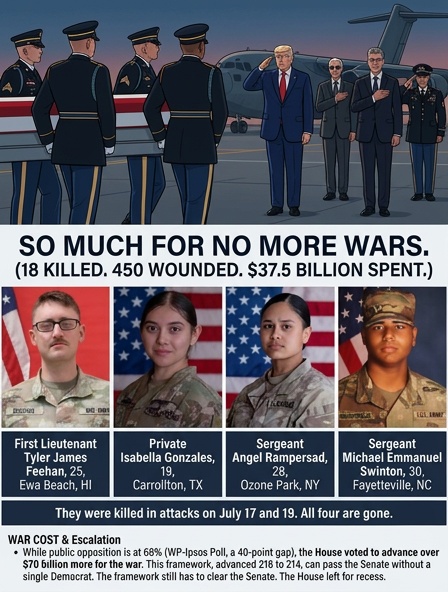
On a poignant day marked by tragedy and political controversy, former President Donald Trump made headlines again with a stark claim about American public opinion and the ongoing war. As he traveled to Dover Air Force Base to receive the bodies of four soldiers killed in Iran’s recent attacks, Trump stopped to address reporters on the tarmac, asserting that “Americans aren’t against the war,” despite mounting evidence to the contrary.
“A poll just came out. Americans don’t want high gasoline prices, but they’re not against the war,” Trump told reporters, neglecting to specify which polling firm he referenced. This assertion clashes with recent nationwide surveys illustrating significant public opposition. The Washington Post-Ipsos poll released last week indicates that 68% of Americans believe the conflict is not worth fighting, with only 28% supporting it. The 40-point gap surpasses opposition levels seen in previous conflicts like Iraq and Afghanistan.
As Trump’s remarks made headlines, House Republicans moved swiftly to bolster the war effort, passing a legislative framework allocating over $70 billion to military operations. The bill, worth $95 billion overall, includes funding for military engagements, farm aid, and initiatives related to Donald Trump’s election overhaul law. The vote was razor-thin—216 in favor, 214 against—and underscores the deep division within Congress on the conflict’s direction.
Despite the public’s unease, the GOP lawmakers pushed the bill forward, leveraging the reconciliation process to bypass the usual 60-vote Senate filibuster. This procedural move enables the legislation to pass with a simple majority, allowing the war funding to proceed without Democratic support. With Congress now heading into a recess of more than a month, questions loom about whether the conflict’s escalation and public opposition will influence future policy
.
Meanwhile, the human toll is unmistakable. The day’s somber events included the transfer of four fallen soldiers’ remains, each draped in flags and carried off military aircraft—the first in the series of losses since Iran launched its recent attack. The soldiers identified include:
- First Lieutenant Tyler James Feehan, 25, Hawaii
- Private Isabella Gonzales, 19, Texas
- Sergeant Angel Rampersad, 28, New York
- Sergeant Michael Emmanuel Swinton, 30, North Carolina
The soldiers died during separate Iranian attacks — three at Muwaffaq Salti Air Base in Jordan and one in Iraq during a drone detonation. Their deaths highlight the ongoing dangers faced by U.S. troops in the region, even as the American public debates the war’s legitimacy and future course.
In the days prior, Trump had insisted that “nobody wants Iran to have a nuclear weapon,” claiming the soldiers’ opinions support taking a hard line on Iran’s nuclear ambitions—an assertion that unsubstantiated by any direct conversations. His comments come amid heightened tensions and renewed focus on Iran’s nuclear program, with the administration urging caution while officials on Capitol Hill debate the appropriate response.
The events underscore not only the human cost of the ongoing conflict but also the political divide shaping U.S. foreign policy. While the public’s opposition grows louder, the legislative machinery continues to push forward, reflecting a nation divided on how to handle its military engagement abroad.