
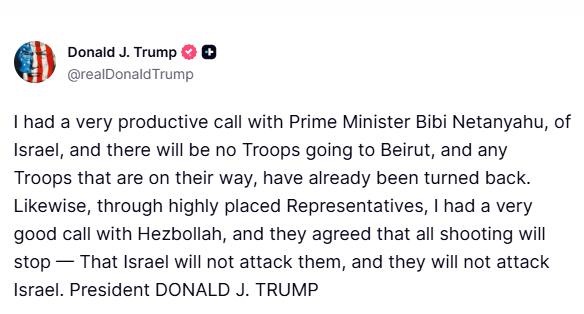
In a significant development amid escalating violence in the Middle East, former President Donald Trump has taken a surprising step to mediate the ongoing Israel-Hezbollah clash, which has raised fears of broader regional conflict involving Iran. According to recent social media posts and sources familiar with the diplomatic efforts, Trump announced that he had a “very productive call” with Israeli Prime Minister Benjamin Netanyahu, during which an agreement was reportedly reached to cease hostilities.
In a statement shared on social media, Trump claimed, “there will be no troops going to Beirut,” signaling a potential de-escalation and reassurance to Israel and its allies. This comes at a critical juncture as fighting between Israel and Hezbollah—backed by Iran—has intensified, threatening to spill over into a wider regional conflict. The situation remains highly volatile, with both sides suffering casualties and the risk of expansion looming.
Adding to the urgency, reports suggest that Hezbollah has agreed to halt all shooting, a move that could turn the tide toward de-escalation despite persistent tensions. This development comes amid fears that Iran’s support for Hezbollah could prolong and deepen the fighting, especially as U.S. and Iranian forces continue to be engaged in a complex stand-off in the region.
While details about the negotiations remain limited, the move reflects a rare moment where diplomatic efforts appear to be taking hold amidst chaos. Experts note that Trump’s involvement signals a recognition of the delicate balance needed to prevent broader conflict, especially with Iran’s role in the ongoing unrest. The U.S. has longstanding strategic interests in the region, including safeguarding access to vital shipping lanes like the Strait of Hormuz, which is frequently a flashpoint for tensions.
The broader geopolitical landscape is also shifting, with recent reports of U.S.-Iran strikes and discussions around a potential new nuclear deal. These moves underscore the complex web of diplomacy and confrontation shaping the Middle East’s future.
As events continue to unfold, international observers remain cautious but hopeful that these diplomatic efforts could lead to a lasting ceasefire, easing fears of a wider regional war. For now, all eyes are on whether Hezbollah’s promise to stop shooting will hold and how the U.S. and Iran will navigate their ongoing strategic rivalry.