
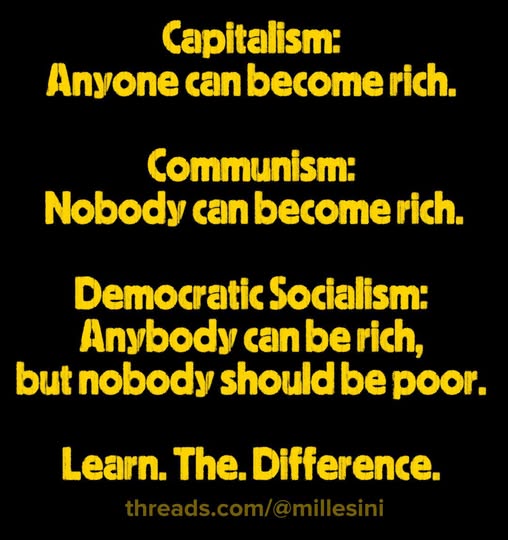
In the ever-evolving landscape of economic and political discussions, a recent social media graphic has captured widespread attention for its provocative and simplified depiction of different economic systems. Titled *”Capitalism: Anyone can become rich. Communism: Nobody can become rich. Democratic Socialism: Anybody can be rich, but nobody should be poor,”* the graphic seeks to distill complex ideas into digestible blueprints, sparking both agreement and debate across platforms.
At first glance, the graphic appears to be a humorous critique of varying economic philosophies, but it also raises important questions about the core principles underlying these systems. Capitalism, often associated with free markets, asserts that anyone, through hard work and innovation, has the opportunity to achieve wealth. Critics, however, argue that it can lead to significant inequality, with wealth concentrated in the hands of a few.
Communism, on the other hand, promotes the idea of collective ownership, aiming for economic equality by eliminating private wealth. As the graphic humorously suggests, this system endeavors to prevent anyone from becoming truly rich, often summarized as “nobody can become rich.” Critics point out that in practice, communist regimes have often faced issues of stagnation and lack of motivation, leading to economic inefficiencies and shortages.
The third component, Democratic Socialism, is depicted as a balanced approach: “Anybody can be rich, but nobody should be poor.” This phrase encapsulates the aspirational goal of many modern welfare states that seek to combine the entrepreneurial spirit of capitalism with social safety nets meant to reduce poverty and promote equality. Countries such as the Scandinavian nations often exemplify this model, emphasizing both individual opportunity and collective wellbeing.
The graphic’s popularity underscores a broader societal conversation about the balance between economic opportunity and social justice. While oversimplified, it serves as a springboard for discussing how different systems impact societal mobility, fairness, and innovation. Experts often note that no system is perfect; instead, countries tend to adapt and blend elements of each to suit their unique contexts.
As debates continue, it’s crucial to understand that these ideologies are rooted in complex histories, philosophies, and practical implementations. Recognizing the nuances behind each system allows for more informed opinions and policies that aim for sustainable growth and social equity.
Where to Learn More
- What Is Capitalism? – Investopedia
- Communism | History & Principles – Britannica
- Understanding Democratic Socialism – Scandinavian Politics Review
- What is Democratic Socialism? An Explanation – Vox