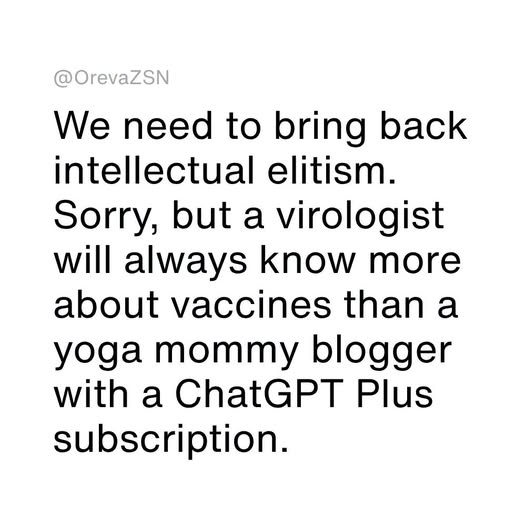
In the age of social media oversimplification and viral trends, a thought-provoking comment has sparked widespread debate about the value of expertise versus popular opinion. A recent social media post that shouted, “@OrevaZSN We need to bring back intellectual elitism. Sorry, but a virologist will always know more about vaccines than a yoga mommy blogger with a ChatGPT Plus subs,” has reignited discussions about the importance of respecting specialized knowledge in our increasingly democratized digital landscape.
The comment underscores a growing tension in today’s information ecosystem. On one side, we have true experts—virologists, scientists, engineers—who dedicate years, if not decades, to understanding complex fields. On the other, a deluge of self-proclaimed authorities, often armed with AI tools like ChatGPT, share opinions that sometimes lack the depth and nuance of specialized training.
This debate isn’t new but has gained fresh relevance amid recent global health crises, technological breakthroughs, and the proliferation of misinformation. Critics argue that equating access to advanced AI tools with genuine expertise dilutes the value of specialized knowledge, which can sometimes be the difference between effective healthcare policy and dangerous misinformation.
Advocates of reviving intellectual elitism believe that society benefits when experts are respected for their depth of knowledge. They warn that sidelining experts in favor of popular opinion or superficial understanding can lead to poor decisions, especially in critical areas like public health, climate change, and technological development.
However, opponents counter that the concept of ‘elitism’ can be problematic if it breeds exclusivity or discourages inclusive dialogue. They emphasize that in a world where information is democratized, the goal should be accessible education and **fostering critical thinking** rather than elitism per se.
What is clear, however, is that the need for genuine expertise remains vital. The rise of AI does not replace the need for human knowledge; instead, it should complement and enhance it. As experts caution, tools like ChatGPT are only as reliable as the data they are trained on, and **critical assessment remains essential**.
In conclusion, the viral social media comment highlights an ongoing debate—should society revert to valuing and respecting specialized knowledge more profoundly? Or should we continue democratizing information, even if that means risking the spread of misinformation? Striking the right balance between open access and respect for expertise might be the key to navigating the complexities of our modern world.
Where to Learn More
- The Role of AI in Shaping Public Understanding of Expertise – The Washington Post
- Why Expertise Still Matters in the Age of AI – Nature
- Public Health and Expert Knowledge in a Digital Age – World Health Organization
- Should We Reconsider the Role of Elitism in Scientific Progress? – Scientific American