
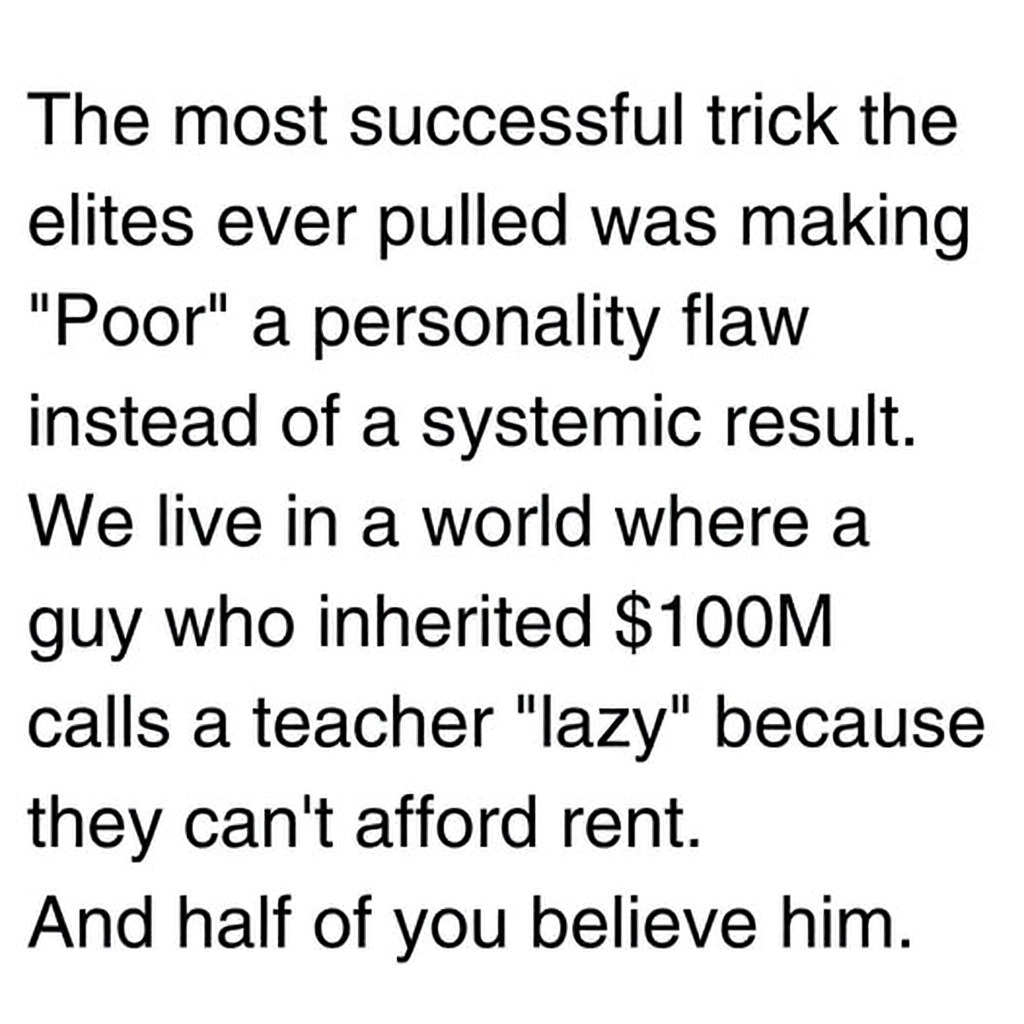
In today’s societal landscape, a seemingly simple phrase has gained viral traction on social media, highlighting a powerful narrative perpetuated by the wealthy and influential factions. The message reads: “The most successful trick the elites ever pulled was making ‘Poor’ a personality flaw instead of a systemic result.” This statement encapsulates a growing critique of how economic inequality is often misunderstood—and intentionally misrepresented—by those in power.
At its core, the idea underscores a disturbing shift in public discourse: instead of viewing poverty as a consequence of structural failures—such as lack of access to quality education, systemic racism, or economic policies—it’s frequently framed as the result of individual shortcomings or moral failings.
Historically, societal narratives have often blamed the poor for their circumstances. From dismissive stereotypes portraying impoverished individuals as lazy or irresponsible to political rhetoric emphasizing personal responsibility, this narrative conveniently shifts scrutiny away from policies or economic systems that favor the wealthy. It also absolves the affluent and powerful from accountability, reinforcing a cycle where systemic inequalities persist unnoticed and unaddressed.
An expert in social justice, Dr. Lena Morales, explains, “By framing poverty as something rooted in personal flaws, society absolves itself from the responsibility to address the structural issues that create economic disparity. It’s a strategic move that benefits the elites, who prefer to keep the focus on individual blame rather than systemic reform.”
Social media users are recognizing this pattern, as viral posts bring awareness to how misconceptions about poverty serve to maintain the status quo. The meme indicates that modern society has effectively “sold” the idea that poverty is a moral failing, when in fact, decades of research confirm that economic hardship is predominantly the result of systemic failures.
This narrative also influences policy debates. When poverty is seen as a personal problem, the push for social safety nets, education reform, and economic redistribution diminishes, leading to policies that favor deregulation and austerity. Conversely, acknowledging economics as systemic requires a deeper commitment to equity—something that challenges entrenched interests.
Understanding this social manipulation is crucial. Recognizing that poverty’s roots lie in systemic issues rather than personal failings empowers advocates and policymakers to pursue meaningful change. It also urges society at large to question the narratives often fed by those benefiting from maintaining the status quo.
As the viral social media message suggests, addressing inequality requires shifting perceptions—viewing poverty not as a moral flaw but as a societal failure—and holding those in power accountable for creating a fairer system.
Where to Learn More
- Understanding Poverty and Economic Inequality – Institute for Policy Studies
- Poverty as Personal Failure? Why We Need to Rewrite the Narrative – Open Democracy
- The Myth of Inequality and Its Impact on the Economy – Brookings Institution
- Poverty and the Cultural Shift in Personal Responsibility – The Nation