
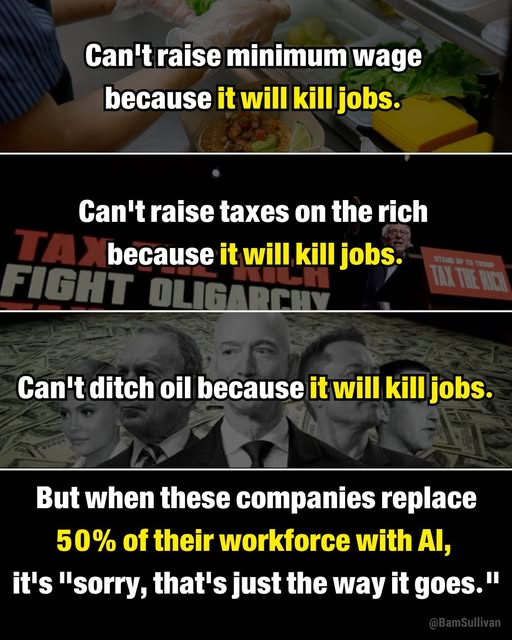
In recent social media circles, a stark image has gone viral, capturing a common refrain in political and economic debates: “Can’t raise minimum wage because it will kill jobs. Can’t raise taxes on the rich because it will kill jobs. Can’t ditch oil because it will kill jobs.” At first glance, these statements seem to represent well-founded concerns about economic stability. However, many experts argue that this narrative may oversimplify a much more complex reality.
The phrase encapsulates a recurring political messaging pattern that portrays any attempt at economic reform as inherently harmful to employment. Advocates for raising the minimum wage, increasing taxes on the wealthy, or transitioning away from fossil fuels often face fierce opposition rooted in the fear of widespread job loss. But is this fear justified, or is it an oversimplification that stifles meaningful policy discussions?
Economists have long debated the actual impact of minimum wage hikes, tax increases, and energy policy shifts on employment. The empirical evidence suggests that the picture is far more nuanced. For instance, studies from reputable institutions such as the National Bureau of Economic Research show that moderate increases in the minimum wage do not necessarily lead to significant job losses, and can even boost consumer spending by increasing the income of low-wage workers.
Similarly, the narrative that raising taxes on the wealthy will decimate job creation is contradicted by research indicating that higher taxes on the rich can fund investments in infrastructure, education, and innovation—elements that contribute positively to economic growth. According to a study by the IMF, equitable tax policies can bolster overall prosperity without necessarily causing job cuts.
Regarding energy policies, the claim that ditching oil will lead to mass unemployment overlooks the potential for green energy sectors to create new jobs. According to the International Renewable Energy Agency, investments in renewable energy have proven to be significant job creators worldwide. Transitioning away from fossil fuels could indeed displace some industries, but it also opens pathways for new employment opportunities in sustainable sectors.
This widespread “paralyzing” rhetoric often serves as a political shield, preventing discussions about long-term strategies for economic resilience and sustainable growth. While concerns about short-term job losses are valid, they should not overshadow the potential benefits of progressive policies. Thoughtful, balanced approaches—such as phased wage increases, targeted tax reform, and investments in green infrastructure—can lead to a more robust and equitable economy.
In the end, dismissing policy changes with blanket statements like “it will kill jobs” may hinder progress. Instead, the focus should be on evidence-based policies that aim for not only economic growth but also social equity and environmental sustainability.
Where to Learn More
- The Effects of Minimum Wages on Employment: Review of the Evidence – National Bureau of Economic Research
- The Economics of Taxing the Rich – International Monetary Fund
- Renewable Energy and Jobs – International Renewable Energy Agency
- Raising the Minimum Wage: Helps Workers and Economies – Brookings Institution
- Green Jobs and Sustainable Economy – U.S. Department of Energy