
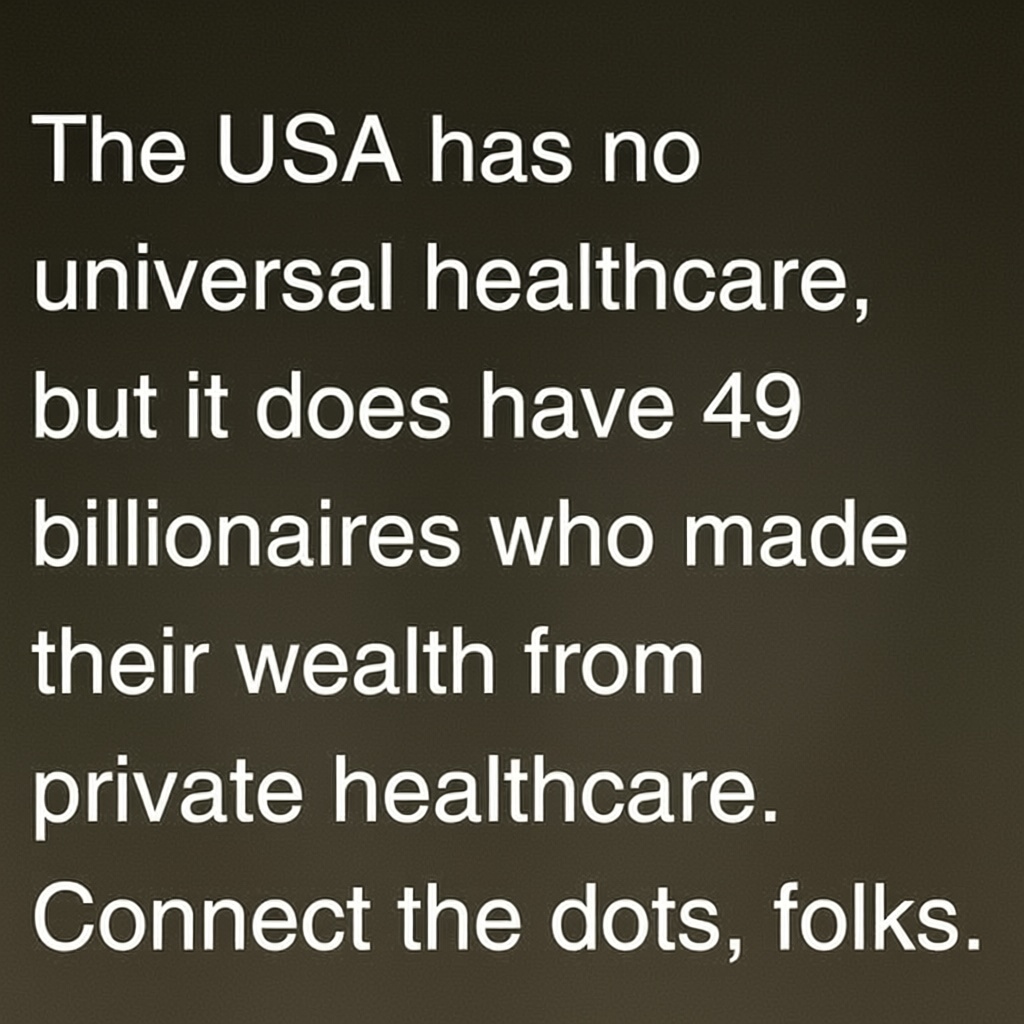
The social media post that’s gone viral recently strikes a nerve: “The USA has no universal healthcare, but it does have 49 billionaires who made their wealth from private healthcare. Connect the dots, folks.” This simple yet provocative statement highlights a stark reality about the intersection of wealth, healthcare, and inequality in the United States.
Unlike many developed nations, the U.S. does not offer universal healthcare coverage to all its citizens. Instead, it relies heavily on a complex, privatized system where access to quality care often depends on one’s income, employment status, or ability to pay. This economic model has created a landscape where billionaires own and profit from the very healthcare corporations that serve millions of Americans.
According to recent analyses, there are approximately 49 billionaires in the U.S. whose fortunes are directly tied to private health industries — including pharmaceutical giants, hospital chains, health insurance companies, and medical device manufacturers. These individuals have seen their wealth soar in tandem with rising healthcare costs, often at the expense of average Americans.
For instance, figures such as the founders and major shareholders of companies like UnitedHealth, Pfizer, and Johnson & Johnson rank among the wealthiest in the country. Their amassed fortunes are directly linked to the high costs, profits, and monopolistic practices prevalent in the healthcare sector. Critics argue that this concentration of wealth contributes to systemic inequities, leaving vulnerable populations underserved.
Meanwhile, millions of Americans struggle to afford necessary medical care, sometimes forced to forgo treatment entirely due to prohibitive costs. The absence of universal coverage means that insurance access—and the quality of healthcare—varies wildly based on income, employment, and geographic location. This has fueled ongoing debates about healthcare reform, with many calling for a system that prioritizes health as a human right rather than a profit-driven enterprise.
Connecting the dots, many understand the critique embedded in the social media statement: the very system that enables these billionaires to flourish is the same system that neglects the needs of the majority. The profit motive incentivizes cost-cutting and consolidation, which often leads to higher prices and reduced patient care options. Meanwhile, the wealth generated by these industries circulates among a small elite, widening the inequality gap and undermining the fundamental principles of equitable healthcare.
This conversation touches on broader issues of economic inequality, corporate influence, and social justice. As the debate around healthcare reform heats up, insights like this serve as a stark reminder of who ultimately benefits—and who bears the burden—in America’s healthcare landscape.