
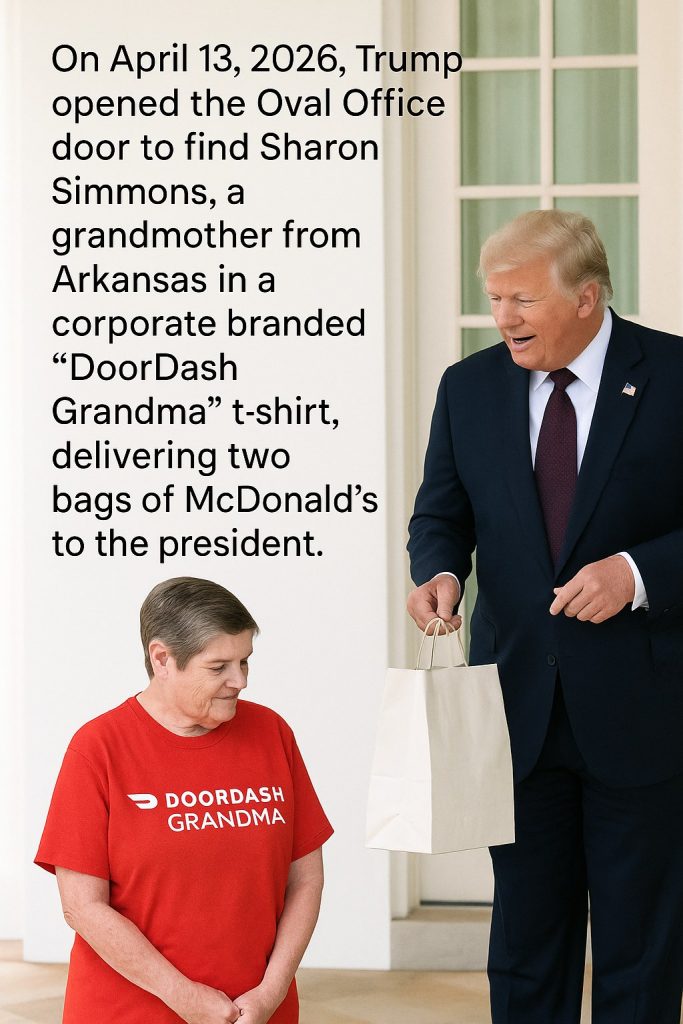
On April 13, 2026, a much-discussed moment unfolded inside the Oval Office that many on social media are calling the most choreographed “spontaneous” event of the week. Former President Donald Trump opened the iconic door to find Sharon Simmons, a grandmother from Arkansas, delivering two bags of McDonald’s while proudly wearing a corporate branded “DoorDash Grandma” t-shirt. The scenes were quickly broadcast on Fox News, accompanying a coordinated DoorDash press campaign. But what appeared to be a heartwarming delivery disguised as a candid lunch drop turned out to be a highly strategic public relations operation.
DoorDash had been a megadonor to Trump’s 2025 inauguration, and they pulled out all the stops for this moment. Alongside the delivery, the company issued a well-timed press release, mobilized their global head of public policy to provide prepared comments, and arranged for Simmons to be immediately interviewed on Fox News right after handing over the food. The entire sequence was more than mere dinner — it was a meticulously crafted PR spectacle.
What made the scene feel less authentic, however, was the awkwardness of the interaction. When Trump commented, “I think you voted for me,” Simmons hesitated: “Uh, maybe.” When the conversation shifted to transgender athlete policies — a hot-button issue — Simmons quickly shut it down, stating she was “only here to talk about no-tax-on-tips.” The centerpiece of the discussion was meant to be the recently promoted tax policy that exempts tips from taxation.
But the numbers cited by both Trump and Simmons raised eyebrows. They claimed that Simmons saved $11,000 thanks to the policy. Independent tax analysts quickly clarified that $11,000 actually represents the total in tips Simmons earned — not the amount of tax saved. Realistically, the average annual tax savings for someone in Simmons’ income bracket is between $1,300 and $3,000, considering Social Security, Medicare, and state taxes still apply to tip earnings despite the exemption on federal income tax. The $11,000 figure, then, was at best misleading.
Worse still is the dissonance between the feel-good PR imagery and Simmons’ real-life struggles. The “DoorDash Grandma” t-shirt is now an official piece of merchandise — a branding exercise adding a veneer of charm over hardship. Simmons herself has completed over 14,000 deliveries driving her own car. She revealed to Fox News that her husband’s 2024 stage-three cancer diagnosis and costly treatment wiped out all their savings. She continues delivering meals to cover mounting cancer bills. This is a stark portrait of a failing system rather than a policy victory.
The optics were equally troubling. Trump tipped Simmons $100 on camera — a gesture some argue falls far short of the real financial burdens her family faces. Gas expenses alone would consume a significant portion of that amount; chemotherapy can cost tens of thousands. Instead of drawing empathy for the crushing economic realities forcing a grandmother to work thousands of deliveries while battling medical debts, the narrative was spun to spotlight a tax policy “win.”
This episode reflects more than just a political ploy. It exposes the precarious reality for many Americans who cannot afford retirement or adequate healthcare. The spectacle of celebrating Simmons as a “DoorDash Grandma” while disregarding her hardships underscores systemic failures in healthcare and labor protections. It is a sobering reminder that behind every viral moment staged for political gain lies the lived experience of millions struggling to make ends meet.
In an era when media moments are crafted to capture fleeting attention, the challenge remains to look beyond social media clips and PR stunts — to recognize the broader implications of policy and the human stories entwined with them.
Where to Learn More
- “Inside the ‘DoorDash Grandma’ Delivery: Politics, PR, and Reality” – The New York Times
- “How Tip-Related Tax Policies Really Impact Workers” – NPR
- “Gig Economy Workers and the Fight for Fair Compensation” – The Washington Post
- “Trump’s Oval Office Lunch Delivery: Stunt or Strategy?” – Politico